
Jersey City Mayor James Solomon weighed in on the long, rocky road that led to the $886,416,892.7 municipal budget with a 15.15 percent rate hike being approved last night in a virtual interview with HCV.
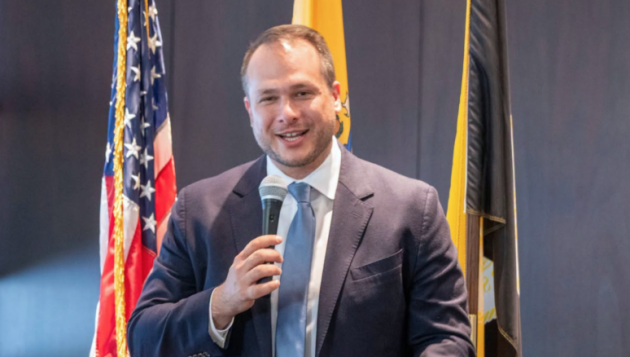
By John Heinis/Hudson County View
Yesterday’s two-hour special council meeting ended an arduous turn of events that began in February, where Solomon held a press conference at City Hall accusing his predecessor, Steven Fulop, of leaving him with an over quarter billion dollar deficit.
“I think it ends a tough process and one that was difficult, but ultimately, my administration made the right choices to to move the city forward as as difficult and as tough as those choices were,” Solomon, who is vacationing out of state, said today.
” … The city faced the worst fiscal crisis in its history, and had we not secured the 120 million dollars of state support and and cut financing by 60 million, or cut our budget by 60 million, yeah, we were facing a catastrophe. We were facing tax increases north of 30 percent and mass layoffs of hundreds of police and fire police officers and firefighters.”
Nonetheless, the final outcome remains a tough one for Jersey City homeowners, with Hudson County’s portion of the tax bill coming out to a 14.42 percent tax increase, and the board of education’s tax hike in the same vicinity – a hardship the mayor acknowledged.
“It doesn’t diminish for one bit how difficult and and painful this process is, and that obviously a huge increase on people’s budgets … is going to be really tough for folks. I have tried to be as honest as I can with the voters, despite the political backlash that came from that, right?” he expressed.
“No one wants to raise their hand and say ‘I’m arguing for a large tax increase,’ but it would have been dishonest for me, starting in June, have not started to level with people and say ‘this is what’s coming based on where we’ve gotten with the state.'”
On June 18th, Solomon called on the City Council to approve a 20 percent tax rate for the third quarter tax bills, which was postponed before a 15 percent proposal was unanimously voted down (0-9) at a July 1st special meeting, all as HCV first reported.
In the midst of all that, the state legislature approved a $120 million relief package for Jersey City, a historic amount for any municipality, in the form of a $105 million loan and a $15 million grant.
Further, the terms of the memorandum of understanding (MOU) with the New Jersey Department of Community Affairs, approved at the July 15th council meeting, mandated that the municipal tax rate could not go below 15 percent.
Solomon said he did not regret accepting the loan, explaining why he felt deferring costs through bonding was not a legitimate alternative.
“The loan allows us to defer the costs at rates that are significantly lower than what we could do in any other way. Spreading the $105 million now over, hopefully it’ll be over 15 years. We’re still working with the state on finalizing that, but our goal would be to do that,” he explained.
“But it’s a much more responsible way of spreading it out than going to the bond market. So had the city bonded first, we could only legally bond for certain costs. We couldn’t have bonded for the full 105 million dollars. Second, you would have had to pay market interest, which is double, more than double, what we’re paying … I understand why people ask the question, but I think the facts are very, very clear that that approach would have cost the city probably tens of millions of dollars more.”
Solomon also pushed back on the notion that the administration exaggerated the seriousness of the deficit, declaring that the Moody’s credit downgrade from December, a state review, and a third-party auditor all came to the same conclusion.
“The audit report verified everything we said, they verified that healthcare budgets were consistently under budgeted, that there were tens of millions in deferred charges, that capital was improperly spent, operating costs were improperly spent out of capital, that long-term obligations were ignored, and that the basic finances the city were completely gutted. So everything we said was verified by an independent auditor that has a legal obligation to provide the truth,” he noted.
“Then you had Moody’s in December 2025. Moody’s doesn’t care one way or the other about our local politics. Moody’s said the same thing when Moody’s downgraded our credit. They said the former mayor governed by short-term bonds, by one-time revenue, and that he created a fiscal crisis … The state’s been looking at our budget since February. They would not have given us 120 million dollars and made a condition of a significant tax increase if they also hadn’t seen our finances.”
Overall, the former two-term Ward E councilman said that the priorities in this municipal spending plan put residents first.
“We do not believe that gutting our city government was the right choice. Ultimately, the number one job of our government is to keep people safe. So we preserved public safety. We did invest in our 911 system because any resident needs to have certainty that when you call 911, they’re going to get a safe, professional answer,” he reflected.
“For me, I was unwilling to cut recreation programs. I believe we have a moral obligation to support our young people, and then we have to provide basic city services. Potholes are a great example of this. Again, the former mayor outsourced our pothole filling through the MUA, our sewer agency, to a private vendor. We get into office in February. We learn the MUA does not have funding this year to pay for the pothole crew.”
He continued that in one month, a new pothole division was created and funded to fill thousands of potholes.
Solomon also said that while he would not commit to any preliminary numbers for next year, he emphasized that the work is already underway to ensure that the tax rate goes down.
“We have to get our 2027 budget in order. That’s job one, two, and three. We have work to do. We still have 25 million in unpaid bills from Mayor Fulop in next year’s budget, so 109 million in unpaid bills this year, 25 million in next year’s budget. So we have significant costs that we still have to factor in, and so we’re immediately getting to work on the 2027 budget,” he asserted.
“We’re doing everything we can to never be back in this place again, we’ve been honest with folks: There will be an increase next year. We will be working very hard on alternative revenue sources. Everything we we can do to try to get get ourselves through that. But we are doing everything we can to avoid the pain of this year, the double-digit increase, and so that that’s what the work is, and we’re working on it every day.”
Solomon added that he and his administration had always viewed getting out of their deficit as a two-year process, noting that state aid in some form will still be sought next year, just not anywhere near the magnitude it was this time around.