
In an editorial, Jersey City Heights resident Kevin Davis reveals why results of a recent Open Public Records Act (OPRA) request have led him to believe Hoboken’s camera-based license plate enforcement for access and response times (CLEAR) program may return.
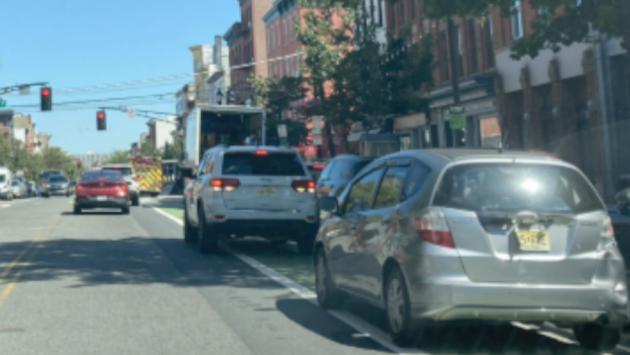
There is already a proposal to make Hoboken’s CLEAR program permanent.
It exists in the form of an internal memo I obtained through an Open Public Records Act request. The memo outlines continuation of the program and projects how much money it is expected to generate.
The memo projects roughly $1.5 to $1.6 million in annual ticket revenue on about $160,000 in costs.
Earlier projections were even higher, over $4.5 million assuming no decrease in illegal parking, and approximately $2.3 million assuming a 50% drop in violations. Both projections fell well short of the amount generated by tickets during the fall pilot.
During the pilot, ticket volumes did not meet the highest projections. That’s a win for safety. But it creates a problem for a system designed to generate millions.
What happens when the numbers don’t come in?
All of it is controlled by unelected officials. All of it is adjustable without a public vote.
Who Pays
The people paying for these policies are the easiest ones to overlook.
Some are drivers with money, others are lower- and middle-income drivers just trying to get through their day. Both groups pay the same fine, regardless of income.
When a system is designed to generate millions in ticket revenue, that money has to come from somewhere. And it comes from people making ordinary decisions in a city that is increasingly expensive to navigate.
Flat fines hit lower-income people the hardest, because they take up a larger share of their income. The same ticket that is an inconvenience to one person can be a real financial setback to another.
That’s what makes this feel less like a safety policy and more like a system that leans on an unsympathetic target, drivers who don’t follow parking laws.
If compliance goes up, revenue goes down. If revenue goes down, something has to give.
A Pattern
This is not happening in isolation.
For years, transportation policy in Hoboken has moved in one direction: higher costs at the curb.
In 2024, Bike Hoboken sent a letter to city officials calling for a 330% increase in residential parking permit costs. This spring, on the day before Good Friday, the City Council proposed doubling those costs.
That proposal was later reduced, but still resulted in a 58% increase. The Council also voted against exempting residents earning below the area median income.
At that same meeting, the Bike Hoboken president described even the 58% increase as “laughably low” and argued rates should be pushed higher toward “market rate” to fund new services and studies.
And it’s hard not to notice something else.
One proposed study tied to expanding Hop service would have paid a consultant with longstanding ties to the local bike advocacy community, including a founding role in Bike Hoboken and a current role in Hudson County Complete Streets.
That proposal came within one vote of approval, and there is still lobbying behind the scenes to reintroduce the same activist connected study.
That does not prove wrongdoing.
But it does show why people start asking questions, especially when the same voices calling for higher fees are connected, directly or indirectly, to the projects those fees would fund.
A More Specific Concern
The CLEAR documents raise a more specific concern, one that is not theoretical.
They show that a former chief of staff to Mayor Ravi Bhalla, who resigned in February 2025, later appears in communications related to the CLEAR program after its rollout in October 2025 (email chain 1, 2, 3 and 4).
Those communications include discussion of rollout strategy, including press releases and public messaging.
Hoboken doesn’t just have a revolving door. It feels like we’ve got a sliding door, you don’t even hear it move.
This raises a basic questions:
What rules exist to ensure that the line between public service and private involvement remains clear, especially when the same individuals appear on both sides of a program that generates millions in revenue?
Because when a system generates millions in revenue, when its enforcement settings can be quietly adjusted, and when the same network of advocates, consultants, and vendors continues to appear around these policies, the question is no longer just what the policy is.
The question is who it ultimately serves.
And who pays for it.
Questions That Need Answers
So before CLEAR is made permanent, before the settings are locked in, before the system expands further, a few questions need to be answered:
Is it fair that automated camera tickets carry the same penalties as those issued by an officer, despite the increased efficiency?
If revenue depends on enforcement, what prevents enforcement settings from being adjusted to meet financial expectations?
When former public officials go on to work with vendors tied to city programs, what safeguards ensure those relationships do not shape policy?
And how can residents be confident that the people designing these systems today won’t benefit from them tomorrow?
These are questions worth answering,because the answers will determine whether these policies serve the public first.
Kevin Davis
Jersey City resident



For a supposed bike “activist” this fool sure loves defending illegal parking, and he isn’t even capable of rubbing two brain cells together since this rag was clearly written by AI.