The Hudson County Board of Commissioners offered their reactions to the preliminary findings of the forensic audit into the finances of the county schools of technology as the county prepares for their budget introduction in May.
By Dan Israel/Hudson County View
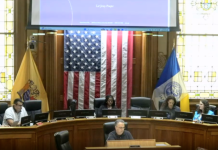
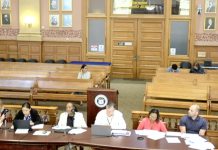
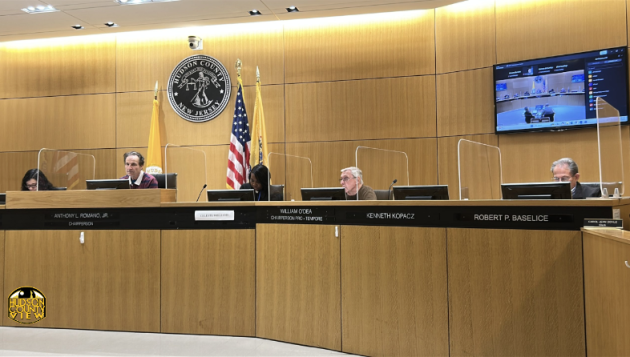
The commissioners began discussing the HCST audit at yesterday’s caucus meeting after Commissioner Bill O’Dea (D-2) suggested that the third-party firm who conducted the audit, PKF O’Connor Davies Advisory, LLC, reach out to former Business Administrator Nicholas Fargo to include his testimony.
“I’d like to ask that whoever the group that conducted that forensic audit, contact the [former] business administrator, who just, I guess was on sabbatical and retired. I’d be quite curious to get that individual’s perspective. If that individual chooses not to want to cooperate, fine,” O’Dea told his colleagues on Tuesday.
“But it would seem to me that most of the things laid out there occurred during the tenure of that business administrator, who I think just recently was on sabbatical and finalized their retirement.”
Although the sitting business administrator for HCST at the time of the financial mismanagement, Fargo was not included in the interviews with staff during the course of the audit for no specified reason.
Without naming him, O’Dea said he recently ran into Fargo and had a short conversation with him. He declined comment about the 12-page forensic audit that HCV exclusively obtained last week.
The audit outlined that the “systemic failure of the accounting and finance department to budget appropriately for the District’s operating expenses from 2022 to 2025.”
Fargo is central to the findings, since the report of the forensic audit’s preliminary findings stating that “internal controls that the district had in place during the period were being circumvented at the request of the former Business Administrator.”
“I think it’s a critical component, so I’m formally asking that we have the forensic auditor to do that and maybe do an addendum to that,” O’Dea concluded during his public remarks Tuesday.
After the meeting, O’Dea told HCV that this is the first step in fixing the finances at HCST, noting that their school board should have done more.
“The forensic audit raises very serious concerns and should only be the start of the process of getting the schools fiscal house in order. Since much of the financial mismanagement was pointed out in the audits and not addressed by the board, it bears some responsibility for the fiscal distress,” he stated.
“One disappointment I have is that there was not enough emphasis on identifying wasteful spending and unnecessary positions outside of the one area where the county lost federal funding for employment and training. Efficiency audits of all non instructional staff is a logical next step.”
Board Chair Anthony Romano (D-5) told HCV that moving forward, HCST will likely need to charge municipal tuition fees to schools districts per student per year that attends their schools to remain financially sound, which was shot down for this year.
He is a member of the HCST School Board of Estimate, a fiscal oversight body that approved HCST’s upcoming $84 million 2026-2027 budget that addresses a $3.64 million deficit carryover, along with other fiscal mismanagement issues that prompted the audit.
“There has to be some kind of discussion on how to implement tuition, like in stages or in phases. That’s probably the proper way to do it, because the schools are in dire financial stress,” Romano expressed.
He emphasized that Hudson County is the only vocational schools district in the state that doesn’t charge tuition or transportation fees.
Although discussions initially yielded a proposed compromise of $3,000 per student, per year, the proposal was killed due to the immediate impact it would have on local school districts amid widespread financial turmoil caused by factors like rising health insurance costs.
At that time, HCST outlined that the alternative would see an increase to the tune of over $10 million to the county tax levy, something that came to fruition with the estimated $13.5 million increase to the levy in the 2026-2027 school year budget advanced by the vocational school district.
County officials hoped for alternative financial solutions, but this was the best HCST officials could manage without impacting instructional programming.
Also on the HCST School Board of Estimate is Commissioner Bob Baselice (D-8), who told HCV that it is a group effort to bring the school district to a healthy state.
“We all have to work together to get us out of this one. We’re in a hole. At the end of the day, we have to come up with some new ideas, grants, different ways of doing things,” he stated.
Baselice noted that tuition fees were on the table for the next budget, meaning they would apply for the 2027-2028 school year. He echoed Romano that it needs to be implemented slowly to mitigate the financial impact to the local school districts.
“This year, increases are going on all over the place, especially with federal dollars disappearing,” Baselice reflected. “
You’re going to start seeing money getting tighter and tighter. So we have to look at all of the aspects of the budget and see where we can and can’t give and take.”
Also at Tuesday’s caucus, officials confirmed to O’Dea that they were unaware of anything regarding HCST that would hold up approval of the county budget before July. The budget will likely be introduced sometime in May.
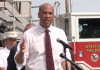
“This audit revealed many hard truths. It is clear the school’s previous administration engaged in questionable budgeting gimmicks, which were hidden from the school board and has led to a ballooning deficit,” County Executive Craig Guy said in a statement yesterday.