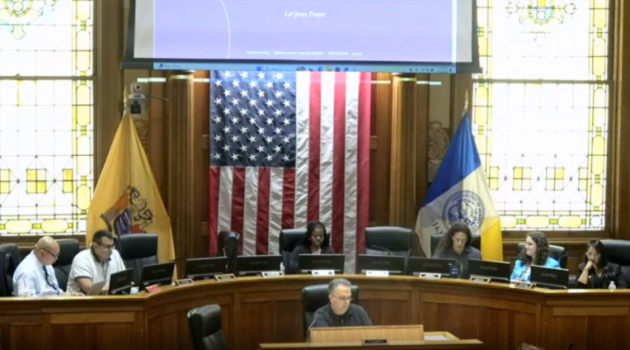
At the budget hearing for the Jersey City Department of Health and Human Services, the council pressed directors over line items and expressed dismay at the provisional layoffs at the department and cuts to senior trip programming.
By Dan Israel/Hudson County View
Jersey City Ward B Councilman Joel Brooks said the employee census of the department was 140 people, of which there were eight of the 31 transitional employees who were laid off earlier this month – the highest number amid the other department lay offs.
Business Administrator Ruby Choi said that all the departmental decisions made regarding the provisional layoffs were hard decisions that weren’t taken lightly following weeks of discussions with department directors on the impacts on internal operations and external services.
“We are unfortunately in the budget situation that we’re in that we had to make these hard decisions,” Choi said.
We focused on provisionals because of the nature of civil service. And again we worked with the departments on input, and then ultimately we had to make this decision as a city.”
She added that this was an opportunity for the council and public to voice their opinions on what the city should prioritize in the overall budget and respective department budgets and how the city should be making financial decisions.
When Ward C Councilman Tom Zuppa pressed further on his question about why that bus driver since he wasn’t a recent hire, Choi said the decision was made following an analysis of provisional employees.
He further asked what a “principal organization specialist” does, to which Ivory-Green said that is an in-house clerical work support position but that given “the nature of their business can not be engaged in all community work.”
Zuppa said that employee was a friend of his, who helped get him elected, but questioned why they fired the existing bus driver for seniors and hired someone in-house who is not able to perform “more of the job than he is able to do” given conflicts of interest.
“I haven’t gotten a good response why our seniors can go out-of-town to Walmart, but we can make these kind of hires,” Zuppa said.
Councilman at-Large Rolando Lavarro said his priority was serving seniors and he was looking to restore jobs and positions.
He said at the Tax Assessor’s Office budget hearing, officials spoke to the ability to create revenue through tax assessments and reassessing property values to create additional ratables.
Lavarro suggested HHS make it a priority to restore revenue-generating positions that may have been cut.
Choi said she remembered the conversation and highlighted the difficulty of the nature of the decision given the impact, but said if she restored the line items for those positions she sought where the council wanted to find funding from elsewhere.
Brooks said he understand, and noted the total sum of the provisional employees that were laid off was $1.9 million annually, and since they are halfway through the year, so it’s about $900,000.
He then said to focus questions on the presentation first before diving into line items, to which Councilwoman at-Large Mamta Singh then asked about the reorganization of HHS.
Ivory-Green said they have only started meeting with the Law Department and Human Resources Department, just starting the process of going through titles and job responsibilities.
She said that would reduce the budget “significantly by doing so,” to which Singh said they might be able to use some employees for multiple responsibilities afterwards.
“That is going to greatly reduce the number of people who can get licenses,” Ivory-Green said.
She repeated she also cut hours for the city clinic since there is only a nurse employed there and security leaves at 5 p.m., as the program monitor who used to stay there in the evening was laid off.
“The clinic must close, actually stop seeing patients by four, so that would allow the nurse to then do the paperwork, finalize, and be done by 5 p.m. and be out of the building by five,” Ivory-Green said, noting HHS reduced hours of operation versus services.
Ivory-Green also repeated that health education, which is state-mandated, lost a health educator in Ward A “one of the most vulnerable populations.”
She said previously there weren’t even enough of them as there were wards, totaling five instead of six health educators, with two co-covering Ward C – prior to HHS budget cuts.
“Not having a health educator for Ward A, significantly impacts. There are now only four health educators left for a city of over 300,000 people that speak multiple languages, that are diverse, that have significantly health needs per ward. So to be stuck with that and left with that, creates such a gap in health services,” Ivory-Green.
” … Now there’s no possible way that they can actually effectively provide education to the level that they should be providing education when there are now two wards that have no dedicated health educator, which is again a core activity and state-mandated.”
Lavarro then inquired about grant funding, as to if future grants that have yet to be awarded are reflected in the budget, to which Choi said that is the case.
He questioned if the offset for the position hired is also reflected, to which Choi said the grants offset existing employees salaries but may be some that are fully funding employees.
According to Lavarro, he suggested that the budget should note which positions are offset by grants in the future, to which Choi noted instances where that was already occurring in the HHS budget.
Choi said the administration can provide a detailed breakdown of which employees are grant funded versus which ones aren’t, and responded to Lavarro that she would provide information regarding if any provisional laid off employees were granted funded in the future.
On the topic of grants, Lavarro asked about behavioral health infrastructure and if it was the ARRIVE Together program and if HHS has a role in it, to which Ivory-Green said it is not that, but they will be working with the ARRIVE Together program in the future just not yet.
She added that it would be primarily under the Public Safety Department and HHS’s role would be in a social service capacity and support for those in need but the framework is still being worked out amid weekly meetings.
“Once I can build my Office of Social Services and put people in those positions, then they would work in tandem,” Ivory-Green said.
Ward E Councilwoman Eleana Little noted that when Mayor James Solomon gave his budget overview earlier this month, she said that HHS was going to see the largest cut of any department at that time to the tune of about $2.8 million in cuts.
However, it was only a reduction in estimated $673,000 from the 2025 HHS budget in reality.
“I was absolutely ready to breathe fire at these meetings, because you know what they say, ‘An ounce of prevention is worth a pound of cure.’ And you are a preventative services department,” Little said.
“Here, I’m seeing in your budget, that it looks like the cuts from the 2025 budget is actually not $2.8 million, it’s $673,000.”
Responding to Little’s concerns over the accuracy of the spreadsheet versus the mayor’s budget overview, Ivory-Green said that the mayor was comparing the adopted 2025 budget versus the proposed 2026 budget.
Choi said that HHS request the nearly $12.5 aforementioned, but the draft budget only includes the also aforementioned estimated $8.2 million reduced by the administration, which was what was compared in the HHS budget presentation.
She echoed Ivory-Green in that Solomon was comparing different numbers than what they were talking about today.
“That’s a pretty big discrepancy and I want to get to the bottom. Obviously, I don’t want the larger number of cuts. I don’t want you to be chopped up with a chainsaw because you do really important work,” Little added.
Choi said she would get back to her on that calculation outside of the spreadsheet, noting there were shifts in costs that were incorrectly accounted for in 2025 that they had to use as a proper comparison since they were appropriating it to the right operating lines in the HHS operating budget.
“I would argue that any reductions in services in Health and Human Services, we’re going to be paying for in other departments,” Little continued.
Zuppa also thanked the department for taking the budget crisis seriously and making painful cuts, before asking about regional partnerships as to what they had in mind with whom and what divisions can be merged or rely on other institutions like the county.
Ivory-Green said the county is already HHS’s greatest partners, providing services that she wants to build and expand on, and seeks to grow that partnership as well as RWJBarnabas Health for clinical social workers to provide additional mental health support for HHS.
Zuppa applauded that, then asked about reducing duplicative work in divisions under HHS to restore eliminated positions, Ivory-Green said that’s part of the planned reorganization and consolidation of some divisions.
“I can’t speak to right now, because I am in meetings with the Law Department,” Ivory-Green said.
“The whole reorganization would significantly reduce some of the budget and reduce some of the duplication of services, eliminate all of the duplication, and just sort of be a more consistent, efficient department.”
On line items, Ward D Councilman Jake Ephros asked about how they are set up, and how grants and grant offsets are reflected, questioning if the total draft budget number is minus the grant money coming in and the council is being asked to appropriate.
Choi said they answered it already and that the budget does include the assumptions of the grants, to which Ephros said those numbers are subtracted in the 2025 draft budget column line items.
In response, Choi said that the budget draft includes a list of grant offsets at the bottom of the page that allows them calculate the impact on salaries.
Diving into line items for the director’s office, Singh asked about a change which Ivory-Green said the reduction there was due to the now discontinued used of contracted professional development consultants.
Council President Denise Ridley said that since its such a large line item not being renewed, she asked if there were any professional development or any certifications that will be lacking in the department.
Ivory-Green responded not in the director’s office, but various divisions will see different impacts as some must maintain certain certifications to keep specific licenses.
Lavarro asked about salaries and wages citywide, inquiring about retirements and resignations, as well as promotions and when they were affected in addition to salary changes.
Choi said they will share all data related to active employees for the last five years, to which Lavarro said he wanted to know about promotions and resignations and retirements from this year thus far.
In regards to the director’s office specifically, Lavarro questioned one salary offset by grants that was a negative number, to which Choi said it offset a salary above.
She said it’s not for specific employee, but deducted from total salaries and wages line items above.
In the Division of Food and Nutrition, Brooks said there is no offset listed there because it is listed under the director’s office, to which officials said that employee was under the Director’s Office but looking to offset their salary in other divisions in the future.
Ivory-Green told Zuppa there were city no city cars assigned to HHS, and that the mileage allowance was for health inspectors, investigators, and educators – as well as directors – out in the field everyday in meetings and work-related events.
She then corrected that there is a pool car under Animal Care and Control, but only one vehicle for the entire division and not assigned to any specific employee.
Lavarro again questioned the grant offset, “beating a dead horse” over a particular line item in the Division of Environmental Health, asking what salaries it offset, to which Choi said she would provide a list of grant-funded employees to the council and at what percent they are funded.
Following up, Lavarro said that he received a document from the Finance Department that showed expended amounts of grants this year thus far but questioned their accuracy, to which Choi said they were accurate of the day the numbers were run from 2025 expenditures and 2026 as well thus far.
In the Division of Environmental Health, Ridley asked about the line item in other expenses about the mileage allowance for $45,000 compared to $5,500 in the director’s office, wanting to know what the average spent per month on mileage allowance tallies.
Lavarro said it was $21,260 in 2025, and this year to date it was $5,865, for Environmental Health, and Ivory-Green said that was because 11 public health investigators and such who are out daily total about $132 per month.
Singh asked about the line item for overtime wages, which Ivory-Green said that includes events that they have to attend for inspections like the World Cup Final and related events on Saturdays, during the evening hours and weekends, and due to short staffing.
“When it comes to Environmental Health, that’s when we’re talking about safety for food. That’s events, festivals, carnivals, they have to just ensure that the vendors are operating safely and if there’s food safety issues,” Ivory-Green explained.
Singh asked if it was possible for those that work overtime work less during the week, Ivory-Green said the workers are unionized and the department needs to follow policy per their contracts.
Lavarro said he wasn’t singling out HHS, but he always examines buffet items that roll over yearly versus how much was actually spent.
He noted he was doing this line by line examination with every department as well.
“In a budget crisis, we can’t do business as usual. We need to like look at these things and question the idea of whether this is truly a necessary expenditure,” he expressed.
“Then we have to right-size it and make sure we’re putting in the numbers correctly before we lay people off, before we raise the taxes on anybody else here beyond the 50 percent that they’ve gotten in the past five years and that we’ve already inflicted upon them with the 15.5 percent or 12 percent that the municipal council approved for the third quarter.”