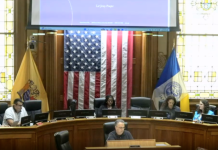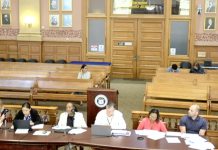
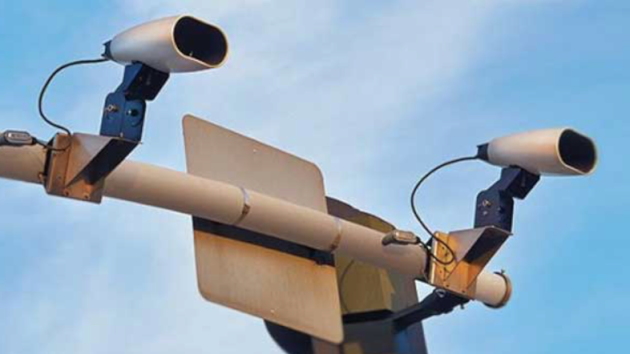
The Hudson County Board of Commissioners again tabled a resolution that would permit Weehawken to install automated license plate reader (ALPR) cameras on light poles under county jurisdiction across the township, this time at the request of Mayor Richard Turner.
By Dan Israel/Hudson County View
Uncharacteristically, Commissioner Caridad Rodriguez (D-7) made the motion to pull the resolution during last week’s meeting and table it for an upcoming meeting, which was then unanimously (9-0) approved by the board.
Board Chair Anthony Romano (D-5) noted that the action was supported by Hudson County Executive Craig Guy, which drew curt praise from Commissioner Bill O’Dea (D-2).
West New York resident Mark Bloomberg thanked the board for removing the ALPR resolution off the agenda amid data privacy and U.S. Immigration and Customs Enforcement (ICE) concerns, though still had questions.
“There has to be an audit trail. We spoke to the mayor. He said he knew nothing about it. And so I don’t know if he’s blowing smoke, but regardless, you must have a process for where these resolutions come from,” he expressed.
According to Bloomberg, proposals for more ALPRs will likely come before the commissioners in the future, so part of what he and other advocates want to do is “continue the education process” on how the technology can still be used by ICE for civil immigration enforcement despite state, county, and local laws and guidelines.
“The cameras are not random. They are used consistently. They take images of every single vehicle on the road,” Bloomberg said.
“Then as far as how they’re used afterwards … it’s one thing if it’s a police officer in a car hitting a specific license plate. We’re not talking about that. We’re talking about permanently mounted cameras.”
Bloomberg said ALPRs are already in use in Jersey City, claiming that between last May and this April, Jersey City conducted 593 nationwide searches of license plates, accessing over 6,000 systems for investigations into crimes such as vehicle theft and robbery.
However, conversely to that, he said all those systems are also able to conduct searches across the country, without notifying Jersey City or any other municipalities.
“That’s the backdoor that we’re talking about. So I know New Jersey and our county has protocols, but this circumvents it all,” he exclaimed.
“ … One of the Houston, Texas, ones that I found, the reason given for them conducting the search was ‘instructing justice, suspicious female filming traffic stop, and making comments about ICE.’ … The point is systems like this are going to be misused.”
Bloomberg was joined by North Bergen resident Vincenzo Bidia, also speaking as a member of Estamos Unidos, in further opposing the ALPRs which he said date back to the post-9/11 era in some places in Hudson County such as Secaucus.
“ … We do want to continue educating ourselves, yourselves, county officials, the municipalities in Hudson County, as well as residents and the general public, that there have already been documented cases in over 5,000 cities that, even where local legislation forbids local law enforcement from sharing data, ICE has somehow circumvented those legal loopholes to still get this data,” he declared.
According to Bidia, ICE is using data obtained by ALPRs to conduct raids in violation of citizens’ privacy rights guaranteed by the constitution, something the county “needs to get a hold of.”
After a number of public speakers on the ALPR issue, as well as the use of an artificial intelligence legal services program, County Administrator Abe Antun noted it says in the resolution that request for the cameras came from the Weehawken Police Department.
“I know that, but I wasn’t going to say it,” Romano stated.
O’Dea, reading from the resolution, further confirmed this: “The Township of Weehawken has initiated a program which will install automatic license plate reader cameras throughout the township of Weehawken. That’s the first ‘whereas.’”
While residents decried how the police could have requested something that the council was not informed about, officials felt that was what happened here and were sure reactive measures would be taken.
“I believe that’s what occurred,” Antun said.
“The mayor will discipline appropriately the police officials that were involved in it,” O’Dea added.
Antun added that the county will take appropriate steps when receiving requests like this to confirm details “with upper management.”
O’Dea felt the mayor of any city involved should have to attach a letter to any resolution the board must also approve to ensure this never happens again, meanwhile, Romano again defended the ALPRs as essential to fighting terrorism and drug trafficking.
“I think a lot of the purpose of the cameras, especially in that vicinity near the Lincoln Tunnel, is not to be bastardized for anything with ICE,” stated Romano, a retired Hoboken police captain.
“The main concern is public safety, for example, of plates that may be considered suspicious with regards to a terrorist activity.”
Romano said when he was a police officer on 9/11, three members of his detail got cancer and one died, emphasizing the technology aims to keep residents safe.
“There’s a reason we have to be proactive instead of seriously reactive, but we have to do it within the reason and the parameters that are stated by the attorney general of the State of New Jersey, to be followed by all law enforcement, which I think the majority do follow that,” he added.
“We have to ensure that you don’t have that broad spectrum, but the main focus of those cameras when they first started was to be proactive to ensure that that tunnel area was not being traversed by anyone that could be suspicious.”
However, advocates, including Weehawken resident Daniel Pontan, still decried that even when local police follow the AG’s Immigrant Trust Directive not to share information with ICE, the technology itself allows inherent backdoor access.
“ALPR AI license plate readers are very much so a backdoor for companies like this to exploit surveillance of citizens but also for the federal government to use as they will. Commissioner Romano, I know you were saying that people who are designated as suspicious are being targeted, and that’s something that is an interest of the state,” said Pontan.
“I would very much impress upon you all that a lot of members of our community have been identified as suspicious and are being targeted. Friends of ours are being taken on a daily basis for this very reason. And I think it’s very, very important that you all understand that when we talk about domestic terrorists, that a lot of those people happen to Black and brown people that are in our neighborhoods.”
After the meeting, O’Dea solemnly referenced the grim reality of the AI and the surveillance state, telling Romano as they stood up from the dais: “As a high school student we read a book, Mr. Romano, called 1984 … George Orwell. Big Brother is here now.”