Hudson County is rolling out a new artificial intelligence (AI) legal services program for its Law Department, according to Hudson County Counsel Alberico De Pierro, sparking public outcry over environmental, data privacy, and immigration enforcement concerns.
By Dan Israel/Hudson County View
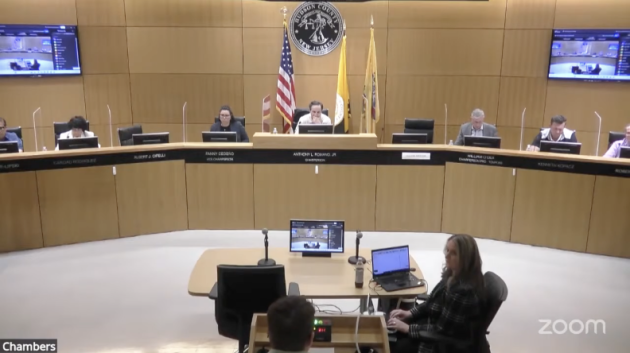
The board of commissioners voted 8-1 to amend an existing contract with West Publishing running until June 30, 2027, to add an additional subscription for AI legal services for the Law Department for $35,000, Commissioner Bill O’Dea (D-2) voting no.
De Pierro told the board yesterday that this is an add-on feature to comply with the American Bar Association (ABA) for use of artificial intelligence for reviewing and analyzing legal documents, researching case law, and producing documents among other uses.
“This is a feature that many lawyers are using in Westlaw, where it allows AI to document summaries,” he said.
“Let’s say you get 30,000 documents of discovery, it allows summarizing. It allows an even higher level of case law research.”
The program is called CoCounsel Legal and is the AI counterpart of Westlaw, an online legal research service and database approved by the ABA.
O’Dea joked that one day De Pierro may be replaced by AI, inquiring how the program works.
According to De Pierro, many law firms are utilizing AI programs like this to facilitate efficiency in research, document summaries, and template generation, among other things.
O’Dea argued that if the AI could do the job of county staffers, it could one day replace them.
However, Hudson County Administrator Abe Antun said staffing wouldn’t be reduced because of the program.
“I just think it makes it more efficient in looking and in doing research and stuff like that,” Antun expressed.
De Pierro told the board that this would expedite the amount of work that Law Department staff can accomplish, having drawn up a department-wide ABA-approved AI policy back in August of last year.
“Instead of having two to three weeks or forty to fifty of staff looking at things like that, now with that it actually makes things happen much quicker,” county counsel added.
“The review is quicker, the analysis, the production of documents, the research. It’s just better ways of research.”
Responding to O’Dea about if AI could make a specific legal determination, De Pierro said he wasn’t sure how that was relevant and noted this program was approved by the ABA, “not ChatGPT.”
This was a subtle jab at O’Dea who used AI to try and clarify related information at the last meeting, albeit for a quick question not a serious legal inquiry.
“That’s completely different from what Westlaw’s AI feature is,” De Pierro expressed.
The board voted nearly unanimously except for O’Dea, who wasn’t “convinced of all this AI.”
“Next thing you know, they’ll try to replace Abe Antun and no one can replace the institutional knowledge that man has,” he said, initially abstaining.
O’Dea changed his vote on the resolution to a “no” after Jersey City resident Courtney Walker noted potential productivity benefits among others but urged caution when implementing AI throughout the county government.
She works for a technology company and said AI is taking the entire field by storm, although she warned to check the AI output for incorrectness or “hallucinations” in its answers.
“AI is often wrong,” Walker said.
“It’s very wordy. The number of work items I have to review now, because other peoples’ output has gone up. So it’s put a lot of pressure on myself and my team.”
On top of replacing or overburdening staff, Walker also raised data privacy concerns, advising the county to proceed carefully when sharing public data considering that AI companies keep and store data to train their models on it.
“Technology companies, the most valuable thing to them is our data and to have us hooked on their product,” she said.
Other residents expressed the reality of AI replacing jobs and “destroying lives,” including Jersey City resident Lily Hecht, who noted that AI serves neither of Gov. Mikie Sherrill’s (D) priorities of affordability and child safety.
“It is profoundly environmentally detrimental. It’s pollution is known to destroy water sources … And all my neighbors are talking about the prices of their utilities. That’s AI,” she said.
According to Hecht, these AI companies crunch public data that ultimately helps the same AI models used in U.S. Immigration and Customs Enforcement (ICE) contracts.
“Westlaw, Thomspon-Reuters, it has a huge ICE contract and it helps them with surveillance,” she said.
“This is all interconnected and the more data, the stronger they get before we even know how to regulate them.”
Hecht urged against using AI at bus stops and on NJ Transit, underscoring examples of the technology being “profoundly and very notoriously discriminatory” in nature.
“There was a mom who, at eight and a half months pregnant, was arrested for highjacking a car because the AI identified her… as the person because AI doesn’t know how to identify especially Black faces,” Hecht said.
“[AI] could subject people to liability for a bunch of things you don’t want liability for… I’m an attorney. Don’t trust AI, it’s not ready for you yet.”
8th District congressional candidate Mussab Ali joined suggested the county put together an AI safety policy amid new technology releases and mounting political pressure by AI companies that he compared to the American Israel Public Affairs Committee.
“OpenAI and some of these companies have built a $150 million SuperPAC that is pushing legislators in Washington to basically deregulate AI, allow as much to happen through ChatGPT, through OpenAI as possible,” he said.
“So when you are thinking about AI policy and how it’s being regulated at the federal level, there is a massive incentive for the people who sit in Washington to do absolutely nothing when it comes to AI.”
According to Ali, the AI lobby has become a “massive boogeyman” that will spend millions to defeat candidates who dare speak on the topic, and its already happening in New York’s 12 Congressional Distric to Democratic candidate Alex Bores.
“That is not just going to stay at the federal level,” he said.
“That is going to trickle down, as we know that it does, to the county level and the city level. And so I think it’s very important that everybody here set out policy in place now, getting ahead of the political pressures, and also trying to get ahead of all of these different AI data centers that are also trying to be built on county land.”
Ali concluded by urging Hudson County, which he called a “pay-to-play system” where “people donate money and they get certain contracts,” to not sell out residents for AI data centers.
He said it’s only a matter of time before data center developers knock on the county’s door offering a lot of money to build on their land, exemplified by the recent “big fight” against AI data centers in Bayonne.
After the speakers, De Pierro told the board nothing mentioned has anything to do with Westlaw and CoCounsel Legal.
“We the Law Department, we defend the county when there’s lawsuits,” he said.
“This is only AI related to helping in legal matters, nothing else. It’s not going to be used to replace any employees. It’s actually going to be used to facilitate how quickly we can respond to matters.”
“If this is the beginning, where does it end? If you’re representing me in a case, I don’t want you relying on AI going through all the case law and all the documents to decide what to represent or not represent me in court … This is legal. These are legal documents that you are going to review, and you’re going to be subject to AI’s thoughts and interpretations on that? I personally just have a problem with that,” O’Dea concluded.