
The Hoboken City Council voted to introduce a $152,128,410.25 municipal budget with a nearly 19 percent tax increase, seeking to address a $17 million deficit driven by rising fixed costs, limited revenue growth, and the exhaustion of one-time funding sources.
By Dan Israel/Hudson County View
At last night’s meeting, Mayor Emily Jabbour said this was a months-long collaborative process aimed at strengthening the city’s financial position, aligning revenues with expenses, and rebuilding reserves.
“We listened to residents and worked collaboratively with the City Council, to make difficult but necessary decisions that reduce the deficit while easing the burden on taxpayers and maintaining the core services the community depends on,” Jabbour said in a statement after the meeting.
The administration narrowed the projected deficit from $17 million to approximately $13 million, which Business Administrator Jennifer Gonzalez said was the result of nearly $1.6 million in spending cuts and $2.5 million in added revenue.
To reduce the deficit by about $3.1 million, the city has implemented a hiring freeze; eliminated and reduced several contracts; renegotiated vendor contracts; implemented operational efficiencies; accounted for collection of unpaid taxes; and saved on healthcare costs through a Capital RX Value Program.
This translated to a reduction in the anticipated municipal tax impact from more than 24 percent to less than 19 percent, with the tax levy totaling $83 million.
For the average assessed property, the projected tax impact decreased by approximately $164 to $3,548, representing an increase of about $530 more than 2025, or $130 more per quarter.
“This budget gap is driven by declining one-time revenues, flat state aid, lower municipal reserves, or surplus that can be used as revenue,” Gonzalez said during the budget presentation.
Surplus revenue totals $7 million, down $5 million from last year ($12 million).
Miscellaneous revenue is up by $400,000 due to two payments-in-lieu-of-taxes agreements coming offline and an increase in court and construction fees, but she said they are using less parking utility surplus as revenue amid losses from parking garages temporarily coming offline this year.
In addition, the city added $1.4 million in revenue to the water utility surplus in the budget, $300,000 in surplus from the parking utility, $600,000 in delinquent taxes, and $200,000 in interest from the hospital payment plan with Hudson Regional Health.
“Revenue is not keeping pace with expenses, and the single largest source of revenue is the levy,” Gonzalez said.
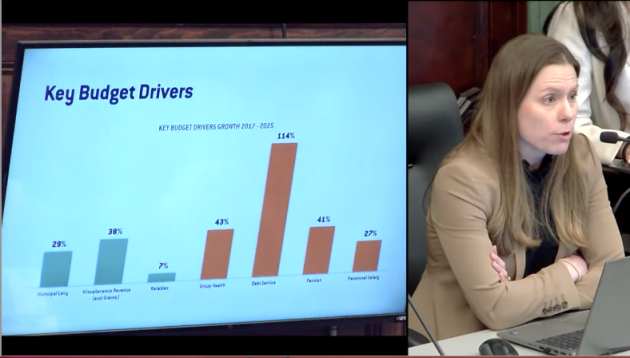
According to Gonzalez, fixed costs are rising including employee healthcare by $3.2 million, debt service by $1.9 million due to the public works facility and waterfront reconstruction project, and personnel costs by $3 million due to previously approved or unsettled collective bargaining agreements.
Further, related personnel healthcare and pension costs have increased by 40 percent.
“On the expense side, the bulk of our increases are driven by costs that are beyond our control. While costs are rising with inflation and purchasing power is down, we still need to fund both recurring expenses and contractual obligations approved in previous years,” Gonzalez added.
According to Gonzalez, this is not a one-year problem but a structural issue in the past solved by “one-time resources” no longer available, like the use of COVID-19 relief funds or various surpluses.
She also asserted that 90 percent of the budget is “non-controllable recurring costs or contractual obligations.”
In February, S&P Global Ratings assigned a negative outlook to Hoboken’s AA+ bond rating, citing the City’s reliance on reserves to offset expenses, with Jabbour announcing the $17 million deficit the following month, both as HCV reported.
The introduced budget is anticipated to allow the city to rebuild reserves and avoid a credit rating downgrade, which would cost the city $6 million in interest for capital projects, place additional pressure on future taxpayers, and reduce the city’s financial flexibility.
Gonzalez also said that she anticipates a $4 million deficit in 2027 and $6 million in 2028 even with corrective action, underscoring the need to avoid short-term fixes in favor of “long-term structural alignment.”
Looking ahead, Gonzalez stressed that previously approved collective bargaining agreements are projected to increase personnel costs by over $40 million over the next six years, 98 percent of which are in public safety.
She said that given the $83 million levy, an $8.4 million increase in personnel costs alone would require a 10 percent tax increase in any future budget.
In addition, the costs of taxes and pensions are estimated at more than $11 million, not including healthcare step increases, longevity, and higher overtime or leave.
Gonzalez also emphasized the need to lower healthcare costs, as premiums are projected to climb on top of the 35 percent increases this year, and the city has a liability for the long-term costs of benefits to retirees totaling about $668 million.
“It is going to take the council working together with the administration to go beyond cutting expenses and to grow revenues,” Gonzalez added.
Before the vote, 3rd Ward Councilman Mike Russo said he wanted a flat tax rate or even a reduction, also disputing that pensions were a driver of the budget deficit since they decreased this year and questioning the $3.2 million increase in employee healthcare expenses.
In addition to more spending cuts, Russo called for increased revenue outside of raising fees, proposed the city change the healthcare fee schedule and providers to reduce claims Hoboken pays.
He also called the administration top-heavy, citing two new assistant directors at the Hoboken Parking Utility as examples.
“One recurring theme I hear all the time is, there are going to have to be some tough decisions made. I think where we all differ are those tough decisions,” Russo said, calling in to the meeting over the phone since he is recovering from shoulder surgery
“For some, the tough decision is pushing the tax burden onto our residents. For others, it’s cutting more of our spending.”
1st Ward Councilman Paul Presinzano, in a wild speech, compared the Jabbour administration to the antagonists of George Orwell’s 1984, stating he was labeled a “disruptor” for speaking out and that her commitment to transparency is not a solution to the budget deficit.
He contended that the budget deficit could be reduced by $9 million, not just $4 million, echoing Russo that the administration is “top heavy” and structural changes were needed on top of spending cuts.
Presinzano also decried fee increases as a “one-time solution” that led to the current situation.
“Say it often enough and people start to buy it. For the past two months, I’ve heard the same thing over and over and over. ‘I’m transparent about the budget process.’ …That’s awesome. However, it’s not a solution,” he exclaimed.
Noting her anger and disputing what Gonzalez considered “one-time revenues” during a tense impromptu question and answer session, 2nd Ward Councilwoman Tiffanie Fisher said overall debt has increased $200 million over the last eight years due to investment in open space and infrastructure without generating ratables or revenue.
She is already working on a budget amendment to lower the tax increase while maintaining Hoboken’s bond rating, and wants to lower tax levy through spending cuts and additional revenues not listed in the budget because the administration is “hiding them.”
Meanwhile, the rest of the council was on board with advancing the budget, including Council President Ruben Ramos, Councilman at-Large Steve Firestone, and 5th Ward Councilman Phil Cohen.
They all praised the new administration for starting the budget process early, being “transparent” about the anticipated tax increase, and incorporating council suggestions already to help close the structural deficit.
“I also believe that when you go out for a big steak dinner, you pay the bill at the end of the night. And I don’t think that we’ve paid the bill at the end of the night over the last couple years,” stated Firestone.
Cohen reminded the council that many budget contributors were key items including debt service for projects or union contractual obligations that the council approved prior.
“Some people refer to steak dinner. I don’t think it’s a steak dinner to have a resiliency park that has transformed Northwest Hoboken,” Cohen began.
“I don’t think it’s a steak dinner to have a seawall that keeps the Hudson River in the Hudson River and out of Sinatra Drive where the driveway and the walkway are collapsing. These are essential things that need to be done.”
The council voted 6-3 on budget introduction, with Presinzano, Fisher, and Russo voting no.







“Here’s your mammoth tax increase for all the rubber-stamping of Ravi’s ludicrous spending. Now it’s my turn. Aren’t I awesome to inflict you with this insane tax increase? Stunning and brave.”
– Mayor Emily
Vote for the pending amendment reductions, you insipid clowns. 🤡
Hoboken becomes even more unaffordable.
Hoboken School taxes up 20% too.
What will your family do without to pay for their mismanagement ?
Councilman Cohen makes fair points on the Resiliency Park and Seawall, however he fails to mention that the Park cost 3 times more than the original estimate and the Damn has been on the books for a long tim and has to be costing more than planned. How much? What other projects are pending – -and are costs coming in as planned? We never seem to get that detail until tax time…. if ever.