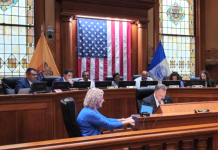
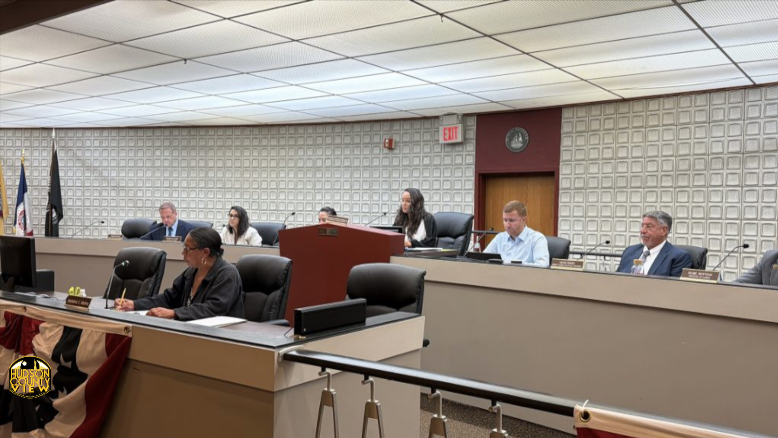
The Bayonne City Council unanimously (5-0) adopted an ordinance to establish the Division of Code Enforcement within the Department of Municipal Services at a brief special meeting last night, fulfilling a campaign promise by doing so.
By Dan Israel/Hudson County View
“Thank you to the council, thank you to Mayor [Sharon Ashe-]Nadrowski, and thank you to the administration for working towards this,” Council President Melissa Godesky-Rodriguez said.
“This was a huge commitment to the residents. The City of Bayonne deserves this … Thank you all for the support and the work behind getting this done so quickly.”
The ordinance was introduced 5-0 at the August 12th council meeting, with a special meeting date of August 26 for the public hearing and adoption, amid residents praising the administration for resurrecting the Division of Code Enforcement.
Godesky-Rodriguez said at the August 12th meeting that there would be a special meeting to adopt the ordinance since it was a priority of the new administration and council.
According to the ordinance, Bayonne has a property maintenance code – as adopted by a previous ordinance – but it does not possess any organized enforcement mechanism to implement these standards.
The ordinance states that the council and administration have found that a lack of an effective, organized enforcement mechanism has caused “interdepartmental confusion” and a “continued erosion of public trust” in the city’s ability to effectively address community concerns.
The effective enforcement of property maintenance standards helps address “unsafe structures, overgrown vegetation, pest infestations, debris accumulation, and other conditions that may endanger residents, erode neighborhood character, and reduce property value,”according to the ordinance.
The ordinance contends that consistent enforcement prevents blight and encourages clean, safe, and attractive neighborhoods where residents and property owners can take pride in their community and that “well-maintained properties help stabilize or increase surrounding property values, while neglected properties can have the opposite effect.”
Within the Department of Municipal Services, the Division of Code Enforcement will be established, under the leadership of a Supervising Code Enforcement Officer, according to the ordinance.
Under the oversight of the Director of Municipal Services, the Supervising Code Enforcement Officer will oversee all personnel and operations of the Division.
The Division of Code Enforcement will be staffed with personnel “in a manner that supports both proactive and reactive enforcement of the property maintenance code,” and through the Supervising Code Enforcement Officer, will submit a monthly report of operations.
According to the ordinance, the report will include, at a minimum, the number of reactive inspections made, the number of warnings issued, the number of summonses issued, and an accounting of the nature of the violations being cited.
Back at the August 5th caucus meeting prior to the ordinance’s introduction, Godesky-Rodriguez had Business Administrator Andrew Casais explain the gist of the ordinance to the council.
“This is establishing the Division of Code Enforcement within the Department of Municipal Services,” Casais said.
“This is the enforcement mechanism for property maintenance and a lot of the quality of life issues that the various municipal departments and the council have received over the last couple of weeks, couple of months, couple of years.”
According to Casais, the city hasn’t had effective property maintenance enforcement in “quite a long time,” so this would establish the framework under which the Division of Code Enforcement would operate.
“It would have leadership, there would be a clerical component which would be comprised of various code enforcement personnel, to be determined in terms of number,” Casais said.
“What we’ve worked out administratively as a framework is the city would be split into zones where inspectors would be assigned principally to both, again, do that proactive enforcement and the reactive enforcement to resident complaints.”
Casais said that the number of employees and depth of the work will be determined by the budget, considering the year is already halfway over.
“That means we are halfway plus, in the best circumstances, through the budget,” he noted at the time.
“So we will do the best we can to stand this up in 2026 and go into 2027 with much more depth and capacity. But this is a starting point to again begin property maintenance enforcement in the city.”