In a editorial, Knitty Gritty JC organizing committee member Courtney Walker reviews New Jersey data from Election Day, making the case that low voter turnout in Jersey City dragged down the rest of the county and state.
 Election night 2024, a familiar scene that repeats every four years. MSNBC’s coverage featured Steve Kornacki running through the results as if they were a sporting event.
As the night wore on, Kornacki gave a special shout-out to Hudson County:
“Take a look at Hudson County… Joe Biden won here by 46 points, tonight it’s 28 points” Kornaki said. “This is one of those giant, core Democratic, counties in New Jersey the Democratic party relies on. That’s a massive, massive, shift.”
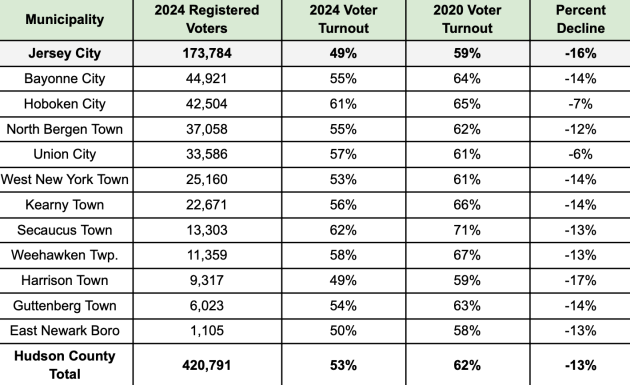
Almost a 20-point shift? How could that be so drastic? Taking a closer look at the TV, something interesting stood out: more than 40,000 fewer voters than in 2020. That’s a 16% decline.
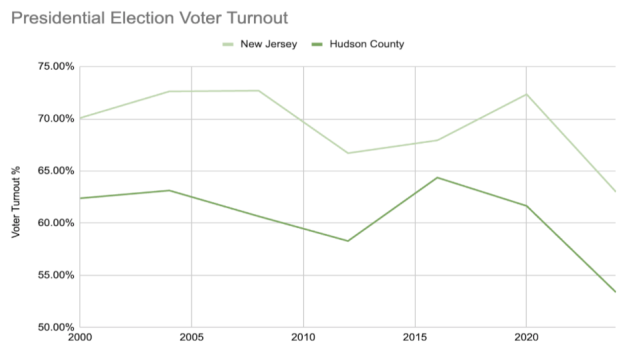
This trend didn’t just affect Hudson County. Voter turnout dropped across New Jersey, which saw its lowest turnout in a presidential election since 2000. (We would’ve gone further, but that’s where the election archives stopped.)
Politicians and pundits have quickly offered various reasons for this year’s low voter turnout.
A New York Times article suggested it was a “Shift to the Right” in New Jersey, but is that really the case? The roughly 9,000 votes Republicans gained in Hudson County compared to 2020 don’t explain the drop in Democratic turnout.
The “shift” seems driven more by low turnout than any significant political realignment, and several factors could be at play.
State and local officials may have failed to effectively communicate the importance of voting. Voters might not have felt connected to either candidate or their messaging. Perhaps they feel disillusioned by politics and choose to opt out.
The truth is, we won’t know why people stayed home unless we ask them. We should be careful not to draw conclusions or make sweeping generalizations before doing so.
Jersey City Mayor Steve Fulop, who represents the city with the worst voter turnout in Hudson County, was quoted in the NYT article saying, “Granted, Democratic organizations across the country didn’t perform well. But New Jersey actually underperformed most similar states, which only reinforces what I have been saying for years: The party machine here is stale, lazy and has shown no interest in growing the Democratic Party.”
Mayor Fulop’s assessment that stale messaging and a lack of effort may have hurt Hudson County’s performance is valid.
However, he should be cautious about relying on strong support from Hudson County in his gubernatorial campaign, given that the county has consistently had the lowest voter turnout during gubernatorial elections.
It seems that his messaging as mayor hasn’t effectively mobilized voters in Jersey City either, which had the lowest turnout in the county this year.
While the county party machine has failed to address the turnout issue, Fulop, as the leader of the largest city, must also take responsibility for this problem.
Here is some of the data for Hudson County during presidential and gubernatorial election years:
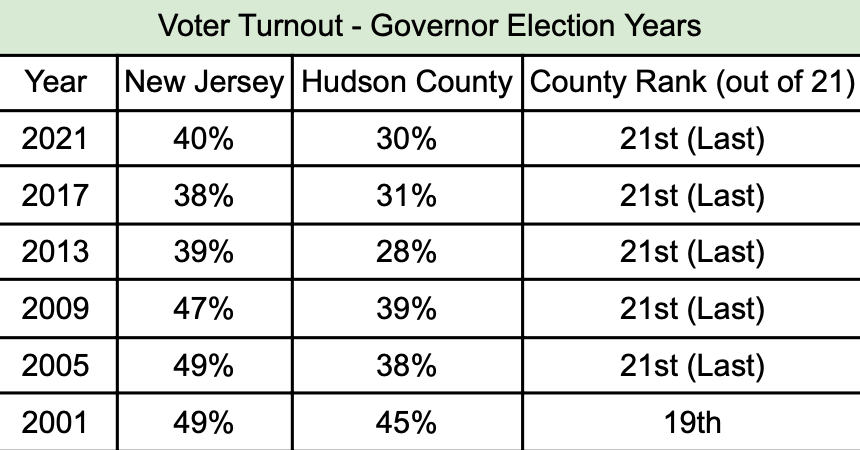
Yikes – we usually come in dead last. And if we’re not last, we’ve never ranked more than three places above it.
So, where do we go from here?
First, we need to understand why voters are choosing not to vote. We should give them reasons and motivation to show up at the polls, and deliver results that make them feel seen and heard.
Jersey City holds the biggest responsibility in addressing this issue in Hudson County.
Here is the voter turnout data by municipality. Not all municipalities are the same—some are much smaller than others—but we can see lower turnout across every single one compared to 2020.
Jersey City clearly stands out in this chart, with the largest group of registered voters in Hudson County and the steepest decline in turnout.
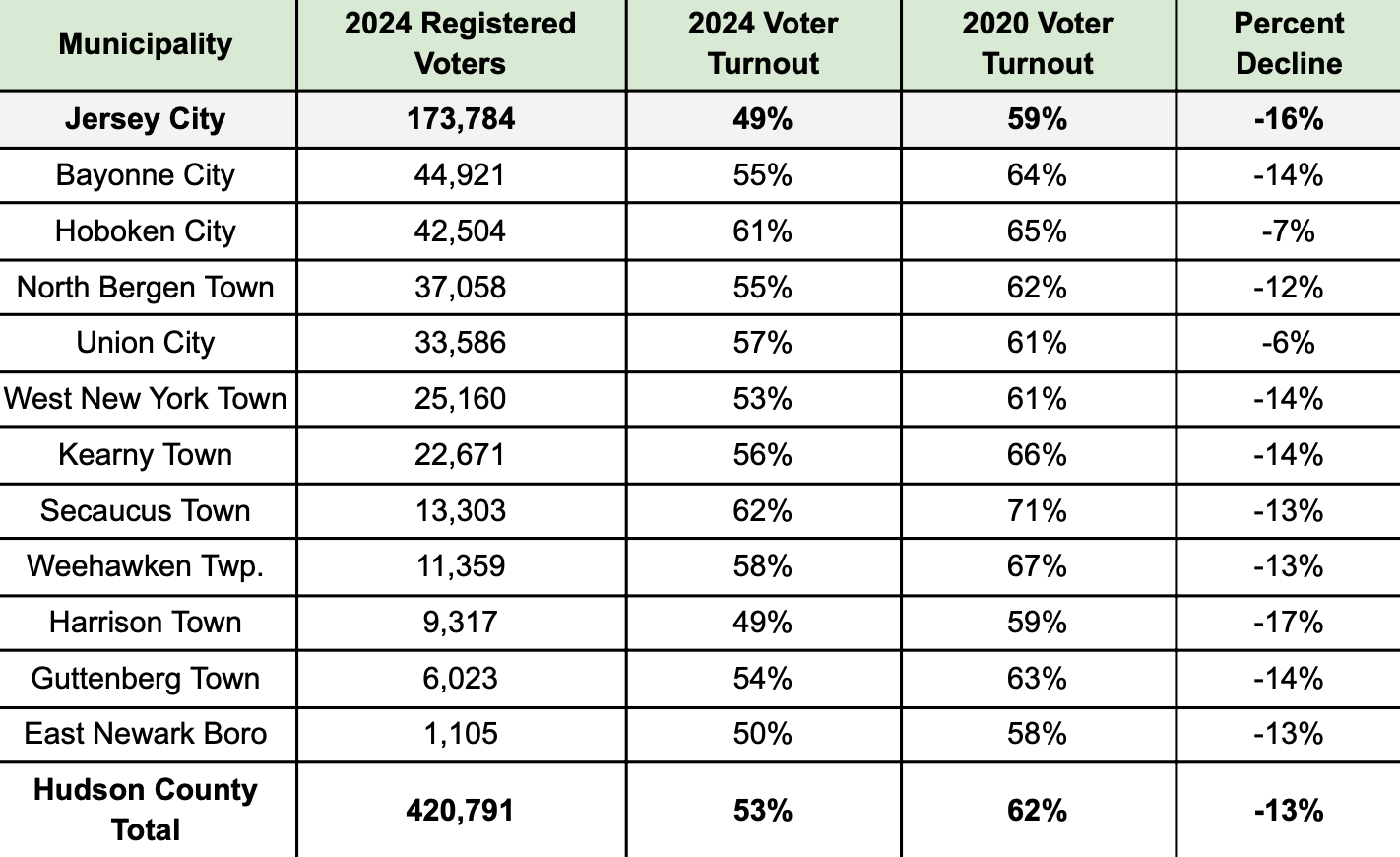
This should be incredibly concerning for Democrats. Jersey City voted 72% for Vice President Harris this year.
To put that in perspective: if we had turned out 62% of voters, matching the rest of New Jersey, we would have added 22,066 votes.
If we had kept the 72% of Harris voters, that would have resulted in 15,888 votes for Harris—enough to make a 0.4% difference in her statewide total. And this is just from Jersey City!
The effect grows even larger when we look at the governor’s race, where fewer people vote overall. In 2021, Governor Phil Murphy narrowly defeated Jack Ciattarelli by 3.2%.
If Jersey City had matched statewide voter turnout, Murphy could have won by an extra 0.6%.
Imagine if we had achieved even higher voter turnout—a 50% turnout rate would have given Murphy a more than 1% boost. Again, these numbers are just from Jersey City—not even all of Hudson County!
After we talk to our neighbors, we need to use the infrastructure we have to engage people in elections. The Hudson County Democratic Organization has the infrastructure to boost voter turnout by engaging County Committee members.
Two members in each voting district can talk to their neighbors about the importance of voting in every election and take responsibility for getting their neighbors to the polls.
I’ll admit, I definitely had to look up my county committee member while writing this article, and I’d never heard of them before.
Also, the Hudson County Dems don’t make it easy to find the information, since their website is fully non-functional (just a main page saying “Coming Soon”). I had to go to the county election archives and dig through the appropriate PDF.
So, with an inactive county Democratic Party, it’s becoming clear that local elected officials, from the City Council to the State House, need to play a more active role in civic education and voter turnout efforts.
It’s unclear what efforts they’ve actually made to address this issue over the past couple of decades, but clearly, they need to change their approach.
Our grassroots organization, the Knitty Gritty JC Social Club, organized weekly local events from the end of July all the way through Election Day.
We wrote get-out-the-vote postcards and letters, coordinated carpools to swing districts in PA and NJ, and participated in local canvassing efforts in Jersey City. However, we are all volunteers. We have jobs, families, and limited time to devote to this.
There is no way we can bridge this poor voter turnout gap in Hudson County on our own.
We need political parties, elected officials, and the county board of elections to ensure that every eligible voter can participate in our democracy.
We also need you, our reader, to reach out to your neighbors. Ask them if they voted or if they’ve updated their registration if they’ve recently moved.
Tell them why you vote and what elections are important to you this upcoming year. In times when it feels like we have very little control, the very least we can do is show up for our neighbors and engage our community to run as effectively as it can.
Courtney Walker is an organizing committee member of the Knitty Gritty JC, a women-led pro democracy group in Jersey City.





This is a great letter full of facts and it invites a deeper dive into the final numbers. I have some questions, though.
Why blame voters for not voting? First, it’s the candidates’ job to earn those votes. Second, why assume they aren’t engaged? When faced with poor candidates and demonizing rhetoric, the most moral voting choice is to refuse to choose the lesser of two evils.
As for the county Democratic Party not updating its website, it is a patronage mill which represents its members, not voters and it’s naive to expect anything but.
Finally, why conclude that voters “moved to the right” at all? As the writer pointed out, Trump’s raw vote total grew only slightly over 2020. Given the economic stress from unprecedented government interference in the economy plus millions of illegals elbowing out the working underclass for jobs, it’s surprising the GOP didn’t do better! That suggests while many people feared an unconstitutional power grab and were appalled by what they saw on January 6th (and October 7th!), they also were fed up with growing inconveniences (no plastic bags, bike lanes instead of parking, etc.) and daily lectures on pronouns, gender fluidity and other antisocial fads from the so-called influential class, and have had enough!
So in a world of nonsense, nearly half the voters chose to elect no one. Now that makes sense!
Guess we’re supposed to believe basement Biden just really got the Democrats excited and eager to turn out the vote by 15 million more votes nation-wide when compared to Obama, Hilary, or Harris! More likely explanation…it was harder to harvest ballots in non-covid 2024.
who created these awful Voter Turnout charts? they should be Bar charts, not line charts. The X axis should have the actual election years, not 5-year intervals. the current carts indicate there was a ~62% turnout for the 2019 Presidential election. Lastly, why use the similar color green for the lines, it should use contrasting colors.
Rookies.
This is a great read and really brings some additional perspective and context to the JC and wider NJ voting scene. Thank you for sharing and to the author for writing!