
The State Health Planning Board (SHPB), under the New Jersey Department of Health (NJDOH), heard testimony from Jersey City residents and the general public yesterday with residents and electeds alike calling for Heights University Hospital to reopen.
By Dan Israel/Hudson County View
While the hearing was originally set for April, HRH got the meeting cancelled with a last-minute temporary restraining order via court injunction claiming they withdrew their application to close the hospital and wanted to reopen it, possibly in a new location.
Although later, after a few days in Hudson County Superior Court, a judge ruled to vacate the TRO and dismiss the case to allow this hearing to proceed now albeit not without an attempted appeal by HRH.
“Today, I have three calls to action. One, we need to protect healthcare access for residents of Jersey City. Two, we need to hold HRH accountable for not following the law at every turn. And three, we need to make sure this never happens again,” said Assemblywoman Katie Brennan (D-32).
Brennan then laid out the community need for Heights University Hospital, the allegedly lawless actions that HRH took, and also what she and her partners in the legislature are doing to find long-term solutions to access to care in the Heights neighborhood.
“It is also our responsibility to hold Hudson Regional Health responsible, so I want to thank you all for your partnership and our work to pass A-5185,” she continued.
“This is the legislation that will debar hospitals from receiving a certificate of need when they have committed these violations, raise fines by orders of magnitude from their current levels. It will ban new hospitals from this expensive, dangerous, and conflicted practice of a real estate investment trust owning the land underneath the hospital, and most importantly, it will strengthen our ability to place hospitals in receivership.”
She continued that a new receiver is needed immediately, with Newark’s University Hospital and Bergen New Bridge Medical Center in Paramus being key examples of county-owned, nonprofit hospital systems.
“No other hospital, is my understanding, has ever closed in this manner, violating so many steps. And finally, ensuring that this never happens again by passing that legislation. What happened at Christ Hospital is a warning about what happens when private operators treat hospitals like real estate assets instead of community lifelines. They are not real estate investments, and we need to treat them that way under the law.”
State Senator Raj Mukherji (LD-32) noted that no “sudden injunctions” stopped the meeting this time, praising the SHPB for holding it and community members for coming to speak out on the need for the former Heights University Hospital in the Heights neighborhood and the city at large.
“When an ER disappears, the patients don’t go away. Our family members’ heart attacks are still going to happen. That stroke is still going to happen,” Mukherji stated.
“The child will still have an asthma attack. The senior citizen who’s vulnerable is still going to have the fall, unfortunately. And the person in mental health crisis will still need help.”
According to Mukherji, data confirms that the remaining hospital, RWJBarnabas Jersey City Medical Center, cannot absorb those patients and those healthcare emergencies without consequence, as HCV first reported.
“We have to look honestly at ER capacity and occupancy, and ambulance response and transport times. and traffic patterns like getting in peak traffic from the Heights to the Medical Center, to Hoboken University Medical Center, and behavioral health needs and the healthcare needs of our growing population,” he added.
“When you look at the residential units under construction in our city today, that population is going to continue to grow. And yet, when it comes to ER capacity, we’re going in the opposite direction, adequate access to care can’t mean simply that another hospital exists somewhere on a map. It means that our residents can actually reach appropriate emergency care or acute care in a timely manner.”
In regards to the CN process for which the hearing was a part of, Mukherji said the state should enforce the law that’s already on the books, and then work together with him and other legislators.
“I want to express my appreciation to Governor [Mikie] Sherrill and to the Commissioner of Health for working with us on the legislative toolkit that will become law to ensure this can’t happen again,” he said.
“But the fact that we might be able to prevent this from happening again, and strengthening the tools in the toolkit, and making penalties harsher, and expanding the ability to secure injunctive relief is not going to.. bring any comfort to the families of the people in this room or in this city.”
Mukherji concluded by calling for full compliance with the CN process, a rigorous assessment of the community’s healthcare needs – which he said means bringing the federally qualified health centers (FQHCs) and acute care providers in the county to the table.
“We will not stand for that turning into condos with views. That is a healthcare site. It must remain a healthcare site, and we have to bring emergency and acute care back to that site… The people of Jersey City deserve nothing less than adequate acute care.”
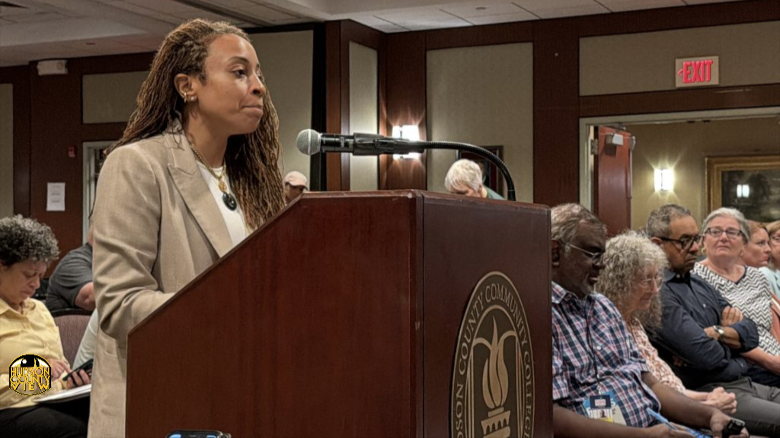
Deputy Mayor of Education Dr. Dia Bryant spoke on behalf of Mayor James Solomon, who is traveling out of state.
“We all saw how Heights Hospital closed outrageously and abruptly, without completing the required certificate of need process and without obtaining the DOH’s prior approval, as you all know, this process is not a technicality,” Bryant declared.
“We believe that such a public review will clearly show that a far greater financial penalty is required and warranted, much farther than the modest $128,000 in fines that DOH has levied so far,” she said.
Specifically, Jersey City requests that NJDOH and the SHPB provide the city with a full two-year preservation period that legally permits following final action on the closure application.
“If HRH no longer intends to fulfill the healthcare mission for which these regulatory approvals exist, these approvals should be preserved so that a qualified entity can,” Bryant concluded.
Ward C Councilman Tom Zuppa said a city of Jersey City’s size cannot operate with only one hospital.
“In the months since the closure of Christ Hospital, we’ve seen the strain on the medical staff and the services at Jersey City Medical Center. We’ve heard testimony from the staff there, and it simply cannot continue… If you look at the timeline and follow the money, the story is pretty clear here,” he began.
“I was at the pep rally at Christ Hospital, I believe it was last October, when HRH told us they’re working with the state, working with our state legislators, and they’re going to make it work. Very few months later, I was at one of my first council meetings. We got an email at 9:30 p.m. saying, ‘Please come to a meeting at 8 o’clock the next morning. We’re closing the emergency room on Saturday.’ That was after they closed down, which was in the region, one of the better stroke centers and hospitals in New Jersey for acute care.”
Zuppa noted that at the end of HRH’s letter to the council that they were closing the hospital, their was a plan to build luxury condominiums on the site that has drawn the ire of the community.
“It said, ‘Well, if you let us build housing there, we can make it work. And I’ve said it before, and I’ll say it to your benefit: It’s very clear that they’re trying to shake down Jersey City for a housing plan for luxury housing. Our residents deserve better. The patients who go there deserve better,” he expressed.
“And you’re our last line of hope here… For this council and for our administration responding to the closure, it’s as if we’re defending the goal line after the opponent already drove 99 yards down the field. And so many residents, who came together, made signs and petitions and are fighting back, trying to hold the line. We need the state to step in and say, ‘Jersey City, our residents, our people deserve better health care.’”
Ward D Councilman Jake Ephros said the hearing should have happened in the fall of last year before HRH shuttered any services at Heights University Hospital, yet that they never should have tried to cease any services to begin with.
“HRH lied from the beginning, claiming that they would be able to operate this hospital, and then they failed on the promise after they closed the hospital, without providing anything like interim care for our community in the meantime,” Ephros said.
“It’s a disgrace. And these illegal closures, both of the normal hospital services and of the ER in the fall and the spring, respectively, cannot go unaccounted for.”
According to Ephros, Jersey City has half the beds that the city should have, as the sole remaining hospital in the city is in “crisis.”
After elected officials, community members of every age, gender, creed, and denomination spoke in favor of preserving the Heights University Hospital license with denying the CN application to close the facility.
“The need is here, the population is here, and the [license] must be preserved,” said lifelong resident Danielle D’Adamo, also an educator and community advocate.
“Every day without access to an ER on Palisade [Avenue] creates compounding harm to our entire community. It means ambulances traveling farther. It means greater pressure on Jersey City’s remaining hospital. And during a heart attack, stroke, or other life-threatening emergencies, it means losing precious minutes. These minutes matter.”
D’Adamo joined residents who highlighted that Jersey City has approximately 300,000 residents and growing but only one hospital.
Ben Silva, representing the Health Professionals and Allied Employees (HPAE) Local 5186, a union representing 220 nurses at the former Heights University Hospital, strongly urged the board to deny the CN application.
“Jersey City is a large and growing city, and we need more than one hospital. The hospital leave that Hudson Regional has left us with is overwhelmed. I was a patient in the Jersey City Medical Center emergency room last week, and it’s packed. We need more beds,” he asserted.
Silva said that while the community needs the hospital, more importantly HRH cannot be trusted.
“We know this because we’ve seen their lies over and over again. They lied to the bankruptcy court when they said that they had the resources and the plan to run all these four hospitals. The hospital is closed … They had no intention of running Christ Hospital, and we know this because the day before my members got a vague and meaningless layoff notice, the city got a plan for 2,000 luxury condos without a mention of a hospital,” Silva declared.
“The plan all along was a real estate grab, and so you need to enforce the law, make Hudson Regional follow the law, hold them accountable because they will not do it themselves. They will tear down this hospital and leave our city with nothing.”
Additionally, Caitlin Duffy-Ryon, of the Save Our Hospital Coalition, stated the group has heard from over 500 residents who wanted to testify on the need for the hospital in the community.
“As the Save Our Hospital Coalition, we intervened in the case and filed an Amicus brief in support of the Department of Health holding this hearing and ensuring that you all were able to move forward with the ability to do your job, because we need you desperately to do your job,” she stated.
“ … Please do something to prevent this from occurring, and hold Hudson Regional Hospital or Hudson Regional Health accountable for the fact that they are gutting the entirety of the hospital system in Hudson County, not just Christ Hospital, but they have converted every single hospital into a teaching hospital.”
In addition to the aforementioned testimony, residents also emphasized need for behavioral health to abate a public health crisis from turning into a public safety crisis due to untreated addiction and mental health.
Not one person spoke in favor of the closure of the former Heights University Hospital or HRH’s actions as operator, but HRH spokesperson Vijay Chaudhuri pinned the blame in part on previous operator CarePoint Health.
“Despite Hudson Regional Health’s historic investments in revitalizing Heights University Hospital, years of severe mismanagement by prior operators, a growing number of uninsured patients, an antiquated facility, and significant cuts to government funding resulted in unsustainable financial losses,” Chaudhuri said in a statement.
“Faced with those conditions, and in an effort to preserve the broader healthcare system serving Hoboken, Bayonne, and Secaucus, the difficult decision to suspend services at Heights University Hospital was made and, as directed by the State Department of Health, HRH filed a Voluntary Closure Application on behalf of Heights University Hospital.”
Public comment will be accepted by the SHPB until September 3, and can be written or e-mailed to the board as input for the decision as to approve or reject the CN application to officially close the facility.