
The Superior Court of New Jersey Appellate Court has ruled that the state owes evidence related to the wiretap in former Bayonne Assemblyman Jason O’Donnell’s complicated 2018 bribery case when he took $10,000 cash while running for mayor.
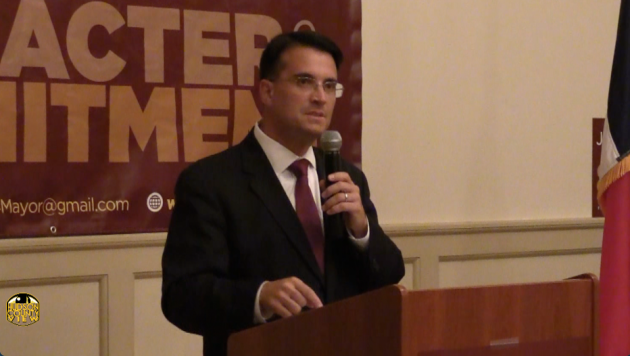
By John Heinis/Hudson County View
“The charge stems from allegations that during his 2018 mayoral campaign, defendant accepted $10,000 in cash from Matthew O’Donnell (MOD) (no relation) in exchange for a promise to appoint MOD tax counsel for the city of Bayonne. Defendant did not win the election,” Appellate Court judges Greta Gooden Brown, Patrick DeAlmeida, and Ellen Torregrossa-O’Connor began in a 36-page decision released Thursday morning.
“MOD cooperated with law enforcement in exchange for leniency. The case was previously before us when defendant moved to dismiss the indictment, contending the bribery statute did not apply to him ‘because it does not cover candidates who accept improper payments but are not elected’ … The trial court agreed and dismissed the indictment … Based on our interpretation of the bribery statute, we reversed and reinstated the bribery charge.”
Jason O’Donnell’s case goes all the way back to December 2019, when he was among a handful of local candidates and/or elected officials charged in a sting by the state Attorney General’s Office, as HCV first reported, where Matt O’Donnell was the cooperating witness.
In March 2020, Jason O’Donnell rejected a five-year plea deal offer from the state, with Hudson County Superior Court Judge Mitzy Galis-Menendez dismissing the bribery charge in June 2021 for the aforementioned reason outlined by the appellate court.
That charge was reinstated by the appellate court in June 2022, a decision upheld by the New Jersey Supreme Court in August 2023, and the case has largely been stuck in quicksand due to procedural and discovery issues the appellate court ruled on today.
With about half of today’s decision dedicated to recounting the evidence and rulings in the case thus far, the trio of judges eventually opined on if the wiretap was legally obtained, as well as what evidence is relevant in Jason O’Donnell’s case.
“Although the discovery is outside the scope of Rule 3:13-3, the communications supporting the authorization of the April 23 consensual intercept is relevant to defendant’s challenge to the lawfulness of the intercept. However, we discern no basis to require the State to produce all communications pertaining to the remaining consensual intercepts, and defendant has advanced no viable ground to require them,” the appellate panel ruled.
“The State argues internal communications concerning an investigation are ‘generally shielded from discovery as work product’ and ‘reflect deliberations concerning prosecutorial policies regarding investigations.’ As no specific documents are challenged, to accept the State’s position would require us to categorically classify all internal communications regarding consensual intercepts as subject to the work-product and deliberative-process privilege.”
The summary of the position the court took in today’s ruling explains where they ended up before noting that the case is being remanded back to Hudson County Superior Court.
“In summary, first, we agree there is no error in requiring the State to produce all communications related to the April 23, 2018 intercept or its authorization in paragraph 3(a). However, defendant fails to advance a viable ground to require the State to produce all communications pertaining to the remaining consensual intercepts, and therefore we discern no basis to require the State to produce them,” the decision says.
“Second, we reverse paragraph 3(b) to the extent it requires disclosure of information beyond the scope of Rule 3:13-3(b) and is not otherwise authorized by our discovery rule. Third, we reverse the portion of paragraph 3(c) requiring disclosure of work product in the form of ‘internal assessments’ not memorialized in an investigative report or a witness statement.”