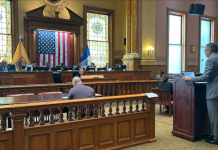
Two bills sponsored by state Senator Brian Stack (D-33) related to making political violence a crime and making cyber harassment of public officials or their families a third-degree offense unanimously cleared the Senate Judiciary Committee yesterday.

By John Heinis/Hudson County View
“I realize that laws don’t necessarily change people’s behavior, people change people’s behavior, and I was grateful for the opportunity to author this bill with [Senate Judiciary] Chairman Stack,” noted state Senator Doug Steinhardt (R-23), a co-sponsor of Bill S-4934.
“While the final impetus of this bill was the assassination of Charlie Kirk, the reality is that any number of events prior to that, quite frankly, should have spurred as to action. As I said earlier, I don’t think any law that we pass will necessarily change people’s conduct or quell some of the political discourse that we have heard or seen of late …”
He further stated that hopefully leading by example will ensure that the parameters of the bill never need to be considered by law enforcement, but there needs to be something on the books for people who resort to violence to silence someone’s freedom of speech.
“An actor is guilty of the crime of political violence if, with a purpose to interfere with or retaliate against a target because of the target’s political affiliation or expression or the political affiliation or expression of another, he commits, attempts to commit, or conspires with another to commit against the target or other victim, a family or household member of the target or other victim, or a bystander,” the bill says.
This would apply to a slew of crimes including homicide, murder, death by auto, assault, kidnapping, criminal, restraint, false imprisonment, sexual assault, criminal sexual contact, robbery, carjacking, arson, or terrorism.
Furthermore, political violence would be considered a first-degree offense, except in the event that the underlying offense is a disorderly persons crime. In that instance, political violence would be considered a fourth-degree crime, based on the bill text.
Also during Monday’s hearing, Senate Judiciary Vice Chair Troy Singleton (D-7) asked why this bill was deemed necessary when bias and intimidation laws with similar consequences already exist in the Garden State.
“Yes senator, the bias and intimidation bill that you reference includes the crime of harassment and crimes like it. The problem with that, from, I think our perspective, and I certainly don’t want to speak for Senator Stack – this was a collaboration – is that they sort of view that as a slippery slope,” explained New Jersey Senate Secretary Addison Hinrichs.
“What might be harassing to you, or harassing to somebody else, isn’t necessarily harassing to another person, and if you’re going to attach penalties to someone, enhance penalties to someone for exercising their First Amendment rights, thought it was important to attach those very specific crimes: an assault, an arson, or God forbid, a murder or a manslaughter.”
The measure cleared the Senate Judiciary Committee unanimously (11-0).
Bill S-3470, which Stack, also the Union City mayor, sponsored by himself, upgrades cyber-harassment to a third-degree crime when it relates to a public servant or their family, establishes the Office of Cyber-Harassment Support, and would appropriate funds to do so.
The exact amount appropriated is not currently defined and will be established at a later date.
Leonard Filipowski, better known as Leroy Truth – a vocal critic of Stack – was the only person who testified on the bill and he was adamantly against it.
“I am here to spoke out against New Jersey Senate Bill S-3470 because it reframes investigative journalism and reporting on corrupt politicians as cyber harassment, which is a direct violation of the First Amendment,” he began.
“I’m here as the person this bill was made specifically to be used against to try to stop me from continuing to investigate and expose the extreme corruption allegations of the very politician who is sponsoring this bill.”
Filipowski also insisted that the bill was crafted with the intention of putting him in jail (he’s been arrested twice in Union City), before Stack interrupted and asked him to keep his remarks on the content of the bill.
The self-proclaimed guerilla journalist had his federal case over his removal from the Senate Judiciary Committee hearing in February dismissed, while the disorderly persons charges against him for the same incident were also tossed.
Once again, Stack said public comments had to be specifically on the contents of the bill or he would be called out or order, to which Filipowski he said his experiences in Union City were directly related to it.
Eventually, Singletary respectfully sought to clarify that Filipowski had some misconceptions on what the bill would actually do.
“This bill would not regulate speech based on content of viewpoint. What it would do is if that speech or that conduct targets a public servant or their family AND meeting the existing criminal standard for harassment … AND is accompanied by an intent to harass, alarm, or threaten, not merely to criticize or inform,” he explained.
He continued that residents still have a right to attend public meetings and express themselves, including being critical of public officials, this bill would not change that in any way, unless the speaker then targeted a public official or their family with cyber harassment.
Nonetheless, Filipowski expressed grave concerns about some of the language of the bill, including:
“Under current law, the trier of fact may infer that a person acted with a purpose to harass another if the person knows or should have known that any of the person’s actions constituting an offense under this section are knowingly directed to or are about a judicial officer and there is a nexus between the offense and relates to the performance of the judge’s public duties,” the legislation reads.
“Under current law, ‘judicial officer’ has the same meaning as defined in section 1 of P.L.1995, c.23 (C.47:1A-1.1). This bill amends the law to permit the trier of fact to make this inference with respect to all public servants, as that term is defined in the bill.”
The bill cleared the Senate Judiciary Committee (11-0).