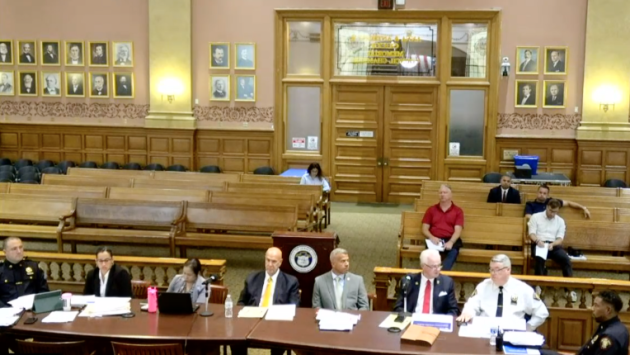
The Jersey City Council sought ways to retain crossing guards and reel in police overtime, among other initiatives, during another budget hearing for the Public Safety Department this morning.
By John Heinis/Hudson County View
” … Are we having a problem with a recruiting, are we having a problem with advertising, people that just don’t want the job, what’s the issue,” Ward F Councilman Frank “Educational” Gilmore asked regarding city crossing guards this morning.
“We get people that want to come in: Retention is what’s difficult for us. It’s a difficult job … most are older, elderly, some experience some type of medical condition after they receive the job and they don’t ever want to return,” explained Police Lt. Travis Ragland.
He added that the part-time nature of the job often means that crossing guards will work one season and decide not to come back.
Gilmore then asked if it was possible to coordinate any sort of job fair or any other recruitment efforts so that police officers don’t have to help pedestrians cross city streets.
Business Administrator Ruby Choi added that this is a common problem in for many police departments, also noting that it is heavily location-based and people often do not want to travel far to the intersection where they’re assisting pedestrians.
“You have a small geographical area where you’re recruiting people, again, for a part-time job with the work environments, no benefits. I think we would love to get your ideas on how to recruit, but I think the geography is also another element to the challenges,” she said.
Councilman at-Large Rolando Lavarro said he had “very preliminary” conversations with their state legislators about changing the civil service title to “crossing guards/parking enforcement officers” in order to offer full-time employment with benefits.
“We could kill two birds with one stone: Make the job more appealing, a full-time salary, and it would also be revenue generating for the city,” he explained.
Public Safety Anthony Ambrose noted that crossing guards fall under a state statute, therefore he thought it was a good idea to work with their state lawmakers to merge the two positions Lavarro mentioned.
Later, Ward C Councilman Tom Zuppa said $120,000 allocation for the municipal prosecutor’s office is “higher than an assistant county prosecutor handling murder cases, it’s a generous number, also our municipal prosecutors are also part time.”
For that reason, he asked the administration to remove two proposed items so the $120,000 can be spent to more pressing matters.
“And also, for the chief [prosecutor] this year, not that the acting prosecutor’s not doing an adequate job, it’s just that if we’re looking to reallocate savings to some of the missed priorities in other departments, those three areas would be worthwhile,” Zuppa, a former assistant county prosecutor, added.
When it came time to address the police department budget, Ward D Councilman Jake Ephros wanted to know the impact of two deputy chiefs retiring at the beginning of the year.
” … In January, we had 10 deputy chiefs. There were assigned to various locations, there were assigned to city command they call it, where they worked around the clock, on the street, 24/7 … supervising lieutenants because lieutenants are supposedly on the street an sergeants behind the desk,” expressed Public Safety Director Anthony Ambrose.
“When I came in, we looked at it, there was no supervision at all in communications. The 911 center was overseen by just a police lieutenant, totally. In all my years, in all my experience, that’s an executive position, so immediately put a deputy chief in charge of the 911 center, with an executive officer whose in charge of the day-to-day operation of the 911 system.”
Ambrose continued that the deputy chiefs were then reassigned to communications, since they are in charge of the police department on any day that the chief is not working.
The department also staggered the schedules of deputy chiefs to that there would always be at least one on any given shift.
After the deputy chief in charge of the traffic division retired, Ambrose felt it was time to reorganize the department, combining the traffic and patrol division. This way, neither deputy chief vacancy needed to be filled.
As the discussion continued, Ward E Councilwoman Eleana Little asked how many active active captains the PD has, to which Ambrose said there are 19 with seven vacancies, compared to Newark which has 33 captains and three vacancies.
She mentioned that their model has more captains than deputy chiefs, to which Ambrose responded that is the route he is going now.
Zuppa then pointed out that the city does not have a ton of workforce housing, therefore he was wondering if Ambrose would ever recommend suspending the residency requirement for new officers.
” … We had one meeting already talking about the residency requirement and we’re gonna follow-up probably in the next couple of weeks, so I can get back to you, through the BA, with more information,” the public safety director replied.
Currently, aspiring Jersey City police officers need two years of residency before they can apply to be on the force.
“Obviously, we’d love to have people serve in the community they live in and have that bond, but I recognize that financial strain with that too,” Zuppa expressed.
He also asked in Class II special police officers were being considered, to which Ambrose said an ordinance is making its way through the Law Department, initially placing them in the courts and at public housing sites.
Next, Ward B Councilman Joel Brooks inquired if the majority of the overtime was going to ranking officers.
” … We’re spending about 1.6 million dollars right now, close to two million dollars, which we could save if we promote lieutenants and sergeants and captains. Mainly the lieutenants rank is where we’re paying the overtime,” Ambrose answered.
“The overtime, believe it or not, isn’t a lower rank working a higher rank, what we’re paying a lot of overtime to superiors that work is manning the four district’s the lieutenant’s position. Each command needs approximately nine lieutenants. There’s only seven, so we’re short 29 lieutenants right now.”
Lavarro noted that the police department’s breakdown in the budget workbook are only updated as of June 30th, to which Choi said they would update it.
Following further inquiries about the police department, the governing body was told there are 767 active officers: the chief, eight deputy chiefs, 19 captains, 44 lieutenants, 106 sergeants, 129 detectives, and 468 police officers.
That does not include the 23 officers in the academy.
Gilmore asked how many are physically on the job, not counting sick leave, vacations, or retirement.
Ambrose said about 13 percent are out sick, injured, or on family leave, 30 percent are off on any given day, 20 percent are on vacation. He added that 111 officers are eligible to leave by 2028, which is not ideal since it takes about two years to recruit and hire.
“The last time I was here, I said I was concerned about the attrition of police officers over the next two to three years,” he expressed.
To close out the hearing, Brooks noted there have been concerns on social media asking if there were any possible plans to close firehouses.
“I never, before this body, said that we were looking to close – the administration or myself – was looking to close fire[houses]. Today was the first time I said to decrease the police budget, I would have to do some closing of precincts, but never did we say a firehouse,” Ambrose stated.