
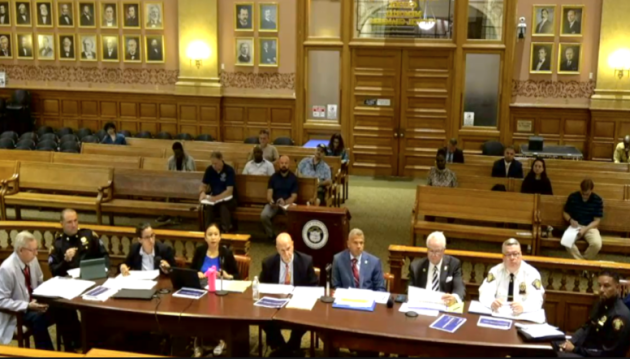
The Jersey City Council held their first budget hearing of the season this morning, reviewing the roughly $219.5 the preliminary budget allocates to the Department of Public Safety.
By Daniel Ulloa/Hudson County View
Public Safety Director Anthony Ambrose explained that the police department was able to recently restart the motorcycle unit with a federal grant, while ARRIVE Together has expanded from two to four days a week, as HCV first reported.
He also noted they saved money by moving certain offices and divisions, while also implementing patrols on the Newark Avenue Pedestrian Plaza – as well as Ocean, MLK, and Bergen Avenues. Ambrose said they have also revised purchasing practices to save money.
“Crime is down while enforcement activity is up sharply,” he declared.
Arrests are up 15 percent, driven by “hotspot deployment,” he said, noting that they are in the process of reducing overtime.
Ambrose also noted that traffic stops are up 176 percent with a new traffic enforcement division up and running since the beginning of the year, bringing summonses for traffic violations up an astronomical 849 percent.
Further, Deputy Public Safety Director Loren Hart added that there is $887,000 worth of contractually obligated raises they have no control over this year, with Ambrose explaining that around 94 percent of their budget is personnel salaries and benefits.
He also provided a by the numbers break down: The police department budget is $105.5 million, the fire department is $81.93 million, IT and communications are $13.4 million, the officer of emergency management is $845,000.
Ambrose also spelled out that there are currently 769 active Jersey Cit police officers, plus 23 in the academy, as well as 681 firefighters, for a combined 1,473 uniformed public safety personnel.
Additionally, the police department has one police chief, eight deputy chiefs, 19 captains, 44 lieutenants, 106 sergeants, 129 detectives, and 462 officers.
“The police division, it’s concerning the attrition. In the last five years, we’ve lost 111 officers … A lot of the young police officers are leaving, going to other departments,” Ambrose said, noting that has required some more overtime in certain circumstances.
“You’re always going to have overtime. You have to control it,” Ambrose noted, indicating that special events, the weather, and of course emergencies all create overtime spending in some way, shape, or form.
Ambrose continued that the police department found $1.7 million in savings largely via better scheduling systems and eliminating fixed posts, while Hart said $781,000 was saved in the fire department.
He added that they have gotten $200,000 in new revenue with more fire inspections, while a new contract with the Port Authority of New York and New Jersey allowing them to use their public safety training facility could generate another $200,000 annually.
Also, Port Authority wants to use their training facility for for $200,000 a year.
Councilman at-Large Rolando Lavarro noted that fiscal officers have been moved around and if that has yielded results in terms of efficiency.
“I made the decision to put them under one house. They were scattered,” Ambrose responded.
Lavarro then asked if the city was moving forward with plans to allow the police and fire departments to allow completely autonomously.
“It’s something, once the budget is approved, we’re going back to the admin to talk about it,” Ambrose replied.
“If we separate two departments wont it be an extra expense?” Councilwoman at-Large Mamta Singh asked, to which Ambrose said it would likely require a new director.
Business Administrator Ruby Choi interjected that more time would be needed to analyze costs after the budget process is completed.
“I was under the impression there was an excess of 23 deputy chiefs. Could you speak to what their roles and responses are?” asked Ward B Councilman Joel Brooks.
Ambrose said they’re down from 10 to eight, which fits overseeing patrols, investigations, support services, professional standards, the 911 call center, along with two night shift captains in the command center.
Lavarro wanted additional information about personnel like chaplains, district clerks, and a domestic violence unit.
“Where do they all fall?” he asked.
“That’s a work in progress for the new organizational chart. Domestic violence is under Investigations. We definitely need a better org chart,” Ambrose asserted.
Councilman at-Large Michael Griffin said there are three police chaplains and two are management and questioned why the two managers are needed.
“Currently, there is no chaplain. It’s something on my to-do list,” Ambrose answered.
Griffin then noted a line item of other expenses said police supplies are $200,000.
“What are these supplies? Other lines lay out specifics,” he further stated.
Public Safety Chief of Staff Jocelyn Roland said it’s for ammunition, gun evidence boxes, flares, and range supplies.
Similarly, Griffin said a line item for a consultant is $89,000 for specialized services and wanted to know what it was for.
Choi said it’s for canine training and psychological evaluations.
“You said there’s no chaplains and two managers. Who are they managing?” Ward E Councilwoman Eleana Little asked.
“There are no chaplains to my knowledge,” Ambrose said.
However, Council President Denise Ridley said her colleagues were likely looking at the itemized budget, which lists Brian Paige as a chaplain under the director’s office.
“I definitely have to look into that,” Ambrose said.
Ridley added Bishop Rodriguez is also listed as a chaplain.
“We’ll follow up with you on the discrepancy,” Choi answered, with Ambrose repeating that their organizational chart needs to be updated.
A short time later, Ward F Councilman Frank “Educational” Gilmore asked how many funded positions in the police and fire departments are vacant and Ambrose said there about 30.
“With respect to vacancies, how much of the overtime is being used to compensate for vacancies?” Gilmore pressed.
“There’s always going to be overtime. A lot of overtime is staffing and supervision,” Ambrose expressed.
“Is there a huge portion of the $12 million trying to compensate for vacancies in overtime?” Gilmore asked.
“A portion of that yes,” Ambrose said, later adding that overtime is largely going towards staffing open positions.
Additionally, Lavarro asked if the administration has considered special law enforcement officers (SLEO) who work part time and receive no benefits.
“One of my assistants is writing up a council resolution to come before you for the hiring of special police officers for a part time basis,” Ambrose said.
“We didn’t have enough time to do the analysis of the ideas you were bringing forward. So, it didn’t make it into the budget,” Choi said.
Responding to questions from Ward D Councilman Jake Ephros, Ambrose said assignments have changed and some senior officers are overseeing minor details.
“We spend a significant amount of overtime on lieutenants. There’s a significant shortage,” he explained.
“Why do we need so many lieutenants?” Singh asked.
Ambrose explained they have many divisions and squads that need a lieutenant managing them.
“Is it an issue with promotions? Gilmore asked.
“We wanted to get the budget straightened out and then do the promotions,” Ambrose replied, stating that promoting 25 officers to lieutenant will save $800,000 in the long run.
Choi also argued that minor discrepancies in a large department occur as personnel move.
Nonetheless, Ephros said the police leasing equipment line item had a $1 million budget shifted to municipal debt service.
“Could you explain what that means?” he inquired.
Deputy Director of Finance Kyle Greaves said the city leased vehicles for multiple years, financed through a third party.
Ephros wanted to know what sort of vehicles are leased, to which Greaves said he’d get back to him.
As others had alluded to, Little was eager for a second hearing to address discrepancies between listed personnel and budgeted personnel.
She noted they made progress over time, but the budget allocates $3 million more for it than last year.
“Is that because 2025 was severely under budgeted?” Little asked.
“It was underfunded in 2025,” Choi said.
“My hope is we won’t need to budget that $12 million going forward. Is that accurate?” Little asked.
“We don’t know any unanticipated overtime,” Ambrose answered.
Little also wanted parking enforcement division costs and revenue numbers, while Gilmore wanted a list of city-owned vehicles driven home.
“We just have to overturn every stone,” he declared.
Singh asked about a new assistant public information officer and a senior information officer in his office.
Ambrose said an assistant handles social media and the dashboard for Impact while the senior officer liaises more with the city.
Gilmore noted fire incidents increased while staff decreased, and asked about a contingency plan.
“We’ve seen fluctuations in a 10-year period,” he expressed.




More interested in the BOE budget. Its bigger than the city and it is jumping every 2 to 3 years. What are we getting for increase. Are students scores going up.
You need to attend a school board mtg and ask those questions and make sure you register with the business office before 3 pm the same day of the mtg in order to speak at the podium and be heard. Test scores are not going up. That is a fact.