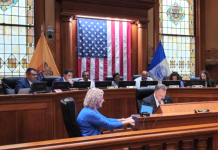
Jersey City Council members Joel Brooks, Jake Ephros, and Eleana Little are all indicating that they will vote to send out the city’s third quarter tax bills with a 20 percent rate hike, citing “extenuating circumstances.”

By John Heinis/Hudson County View
“Residents have asked where we stand on the proposed estimated property tax bill, with a 20 percent increase,” the trio said in a joint statement.
“While we plan on supporting the estimated bill under these extenuating circumstances, we still have questions for Council Caucus tonight, and it is not yet a commitment to any budget that would finalize such a high increase.”
The three local elected officials also acknowledged that 20 percent is significant, which will be felt by seniors on fixed incomes, working families, and longtime neighbors, some of whom may have to move for affordability reasons.
“A tax that pushes our most vulnerable residents out of Jersey City is incalculable, and it weighs heavily on how we are approaching this vote,” Brooks, Ephros, and Little added.
“If we avoid this estimated tax bill for quarter three, and wait until after a budget is introduced and budget hearings are held, any 2026 increase would be concentrated entirely in quarter four, an even more painful shot for homeowners.”
On Thursday, Mayor James Solomon announced he was proposing a 20% tax hike in the Q3 bills to residents, which came 24 hours after alleging that City Hall was grappling with $109 million in unpaid bills from the prior administration, both as HCV first reported.
The council representatives for Ward B, D, and E indicated that there is pressure from Trenton to get the Q3 tax bills out before the state budget deadline on June 30th, noting that the amount of aid they receive “is conditioned on getting our house in order through increased taxes.”
They city is asking the state for a total of $150 million, which would come via transitional aid and/or loans.
“The tax increase and the aid were designed to work together. The Administration proposed the 20 percent hike with that $150 million in mind,” the council members expressed.
“If the state pulls or lowers the aid, the tax increase alone does not fill the hole, and the city faces a collapse of already struggling services and deep austerity. That is what we are trying to avoid.”
Brooks, Ephros, and Little add that a local income or sales tax can only be made possible by the state legislature, further stating that they cannot tax wealthy properties under a different rate under the state constitution.
The Solomon administration said last week that a full budget will be presented to the governing body at the July 13th caucus.
The budget would then be introduced at the July 15th council meeting, with budget hearings taking place between July 13th and July 24th. In that planned scenario, the municipal spending plan would be approved by mid- to late August.
The Jersey City Council will convene for their caucus meeting at City Hall, 280 Grove St., at 4 p.m. with the public session also streaming live on Microsoft Teams.