
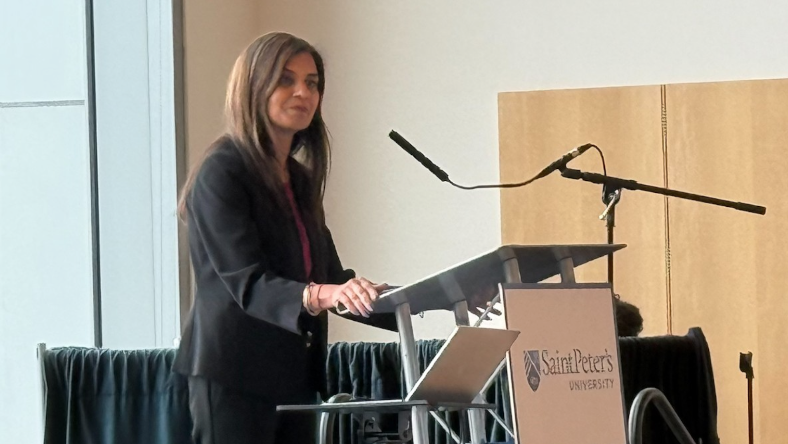
New Jersey Transportation Commissioner Priya Jain detailed preparation ahead of the FIFA 2026 World Cup, extending the Hudson-Bergen Light Rail, and other key initiatives at the North Jersey Transit Forum put on by Hudson County Complete Streets on Saturday.
By Dan Israel/Hudson County View
In her keynote address, Jain, also chair of the New Jersey Transit Board of Directors, began by recognizing the work of the advocacy community for their efforts to build a safer, more accessible, and more connected transportation system for the people who rely on it daily.
“People experience transportation in New Jersey as one journey, not as separate agencies or different jurisdictions,” she said at the event hosted at Saint Peter’s University.
“It’s just one network that gets them from first mile to last mile. And our responsibility is to make that network work better, safely, reliably, and in a way that connects people to communities and to opportunity.”
According to Jain, Hudson County is at the center of major transportation efforts, especially due to the World Cup, where eight matches will be played at the temporarily renamed New York New Jersey (MetLife) stadium including the final on July 19th.
Many of the hundreds of thousands of visitors attending the World Cup matches and related events will stay at lodgings across Hudson County, including Jersey City, Hoboken, and Secaucus, as well as travel using public transit.
“This is the largest transportation, security, and operational challenge, not just in New Jersey Transit’s history, but also in New Jersey’s history,” Jain said.
“And the challenge is not just moving an extraordinary number of visitors, it is doing that while continuing to serve the millions of people who depend on our transportation network every day to get to work, schools, appointments, and more.”
Jain said last summer, NJ Transit supported nine FIFA World Cup matches and delivered 150,000 trips, which directly informed their mobility plan announced last week for upcoming matches.
“At the center of that effort is the Secaucus Meadowlands Transitway, a dedicated bus connection between Secaucus Junction and the stadium,” Jain said.
“This Transitway will help move people more safely, more efficiently around the Meadowlands. It will reduce congestion and also improve connection between different modes of travel during high demand events.”
According to Jain, to enable the Secaucus Meadowlands Transitway, roadway improvements, traffic signal upgrades, and enhancements to the bus plaza in Secaucus are well underway – renovations that will not disappear when the tournament is over.
“For that next concert, for that next event, it’s just for all of us as residents of New Jersey, and for Hudson County,” Jain said.
Further, Jain touted the opportunity of the moment, not only for local economic activity for businesses, hotels, restaurants, and retailers, but to show “what is possible” when transportation agencies, counties, municipalities, and regional partners align with a common objective.
For the first time in NJ Transit’s 47-year history, both its bus and rail fleets are on track to be fully modernized by 2031 as part of a $3 billion effort to improve reliability and customer experience across the system, marking a massive investment in mobility in New Jersey.
NJ Transit is introducing 40-foot buses as part of the 550 authorized in 2023, with 250 expected to arrive by the end of the calendar year, including safety features like blind-spot cameras and pedestrian turn warning systems, and low floor designs for faster and more accessible service maintenance.
“This investment builds on more than $1.7 billion already spent on more than 1,400 new buses with more than 1,000 delivered since 2018,” Jain stated.
“Many of those are higher capacity articulated buses, the ones that look like an accordion in the middle, and those have been especially important in meeting service demand here in Jersey City and Hoboken.”
On rail, Jain noted that Gov. Mikie Sherrill (D) recently welcomed the first of the 374 new multi-level railcairs- the largest such investment in NJ Transit history- with 40 of the “more reliable,” next-generation vehicles to be delivered by the year’s end.
This year, NJ Transit will begin overhauling its current fleet of 429 multi-level railcars through a $1 billion investment that will extend through the life of the fleet and standardize equipment.
She added they are also advancing the light rail extension to the under-construction Bayfront development on Jersey City’s West Side, pursuing federal funding to move the project forward.
“Here in Jersey City, bringing it close to home, we are advancing the planning and design for the Route 440 extension to bring the Hudson-Bergen Light Rail from Westside Avenue into Bayfront, including a new wire deck over Route 440 that will better connect this growing district to the regional network,” Jain explained.
Also progressing is the HBLR northern branch expansion as well, with NJ Transit having requested proposals to prepare an update draft environmental impact statement for the 10-mile extension from Tonnelle Avenue in North Bergen to Inglewood Hospital in Bergen County.
NJ Transit is additionally reevaluating its bus network in Hudson County through the NewBus Hudson initiative, engaging with riders and local officials to better align service with current travel patterns and future growth.
“Alongside these larger capital efforts, we are also focused on what I call the basics, practical, visible improvements that make the system easier to use,” Jain said.
“They may sound small compared with major capital projects, but if I look at all of us here, and for riders, reliability matters.”
In Hudson County, she said that includes the digital bus stop pilot for solar-powered, real-time signs in Hoboken, Union City, and Jersey City that provide arrival information, detours, and bus occupancy levels.
None of these improvements happen without funding, she said, so NJ Transit and other stakeholders have an obligation to riders and taxpayers to make sure that they manage public resources, responsibility, and maximize the value of existing assets.
“NJ Transit owns more than 8,000 acres of property across the state, and for the first time, we are taking a more disciplined approach to turning under … utilized assets into a long-term public value,” Jain said.
Over the next 30 years, the land plan has the potential to generate nearly $2 billion in revenue for New Jersey Transit, drive approximately $14 billion dollars in statewide economic impact, deliver up to $16 billion in new municipal revenues, and support as many as 20,000 new housing units and 50,000 jobs, she said.
“It is about strengthening New Jersey Transit’s financial foundation, reducing pressure on fares and subsidies over time, and creating more flexibility to reinvest in service,” Jain said.
“And from a statewide transportation perspective, it is also about better aligning transportation investment with land use so that growth happens around mobility rather than against it.”