
In an editorial, Jersey City Heights resident Daniel Bogre Udell explains why he supports the proposed bike lane at Manhattan Avenue and Franklin Street.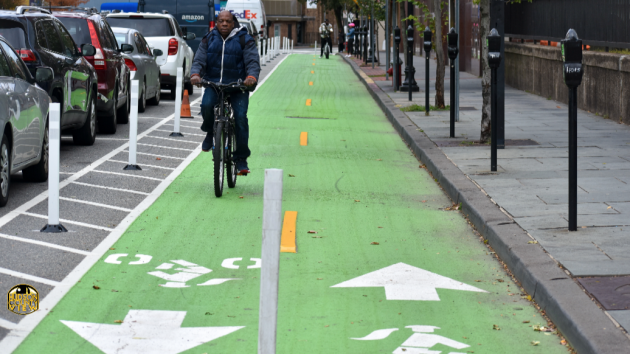 Perhaps the most frustrating dynamic of the year-long debate surrounding the proposed and already-paid-for Manhattan-Franklin protected bike lane has been the extent to which some opponents claim to represent the majority, casting their individual opinions as the consensus of “residents” and “the community.”
As the project enters a fate-deciding stage, I’d like to explain myself as a resident and community member who wants to see a protected bike lane on Manhattan Avenue and Franklin Street. My name is Daniel.
I live in Ward D. I volunteer at the Western Slope Community Garden, which my neighbors, who also support bike lanes, founded. Here’s why I like the project.
As a rule, I support bike lanes because they’re well-tested infrastructure with compound benefits.
In every country and every city where bike lanes have been installed, including Jersey City, they’ve made streets less dangerous for all ages and eased the cost of living by reducing car dependency.
When built at scale—as complete networks, not patchwork partial routes—they improve air quality, reduce noise pollution, and alleviate traffic, making it better for people who need to drive.
They solve many of the same problems that public transportation solves, all for a fraction of the cost; and when they’re installed at the expense of driving lanes, preserving street parking, as the proposed Manhattan-Franklin bike lane would be, they don’t infringe on anyone’s ability to own or use a car. Bike lanes make for safe, fair streets.
In the spirit of safety and fairness, I support bike lanes everywhere, but I’m especially ardent about Manhattan-Franklin because I live along the proposed corridor.
I bike because it’s the best way for me to travel. My wife and I don’t own a car. Transit alone is unreliable. Ubering everywhere is expensive. Meanwhile, biking is free and fast.
I can get to the PATH train in 10 minutes, downtown in 15 minutes, and my Ward B synagogue in 20 minutes.
Biking makes Jersey City accessible, but it’s not yet safe here, where I’m more likely to be seriously injured or killed on a bike than I am in Hoboken or New York.
I’m willing to take that risk, and I mitigate it by carrying non-owner’s car insurance, but my wife, friends, and neighbors aren’t. The absence of safe bike routes, then, means that travel is more dangerous for me, slower and more expensive for them.
A quality crosstown bike lane would open up the Heights, which takes up to 30 minutes to cross on foot and has no serious cross-town transit options.
The Manhattan-Franklin bike lane would reduce any round trip from an hour or more to 15 minutes or less, making it possible for residents to safely and quickly access our schools, businesses, and parks without a car, all while being measurably less likely to die.
Saving time and staying safe—are these not benefits for which our city should build?
Manhattan-Franklin would also connect to any future north/south bike lane in the Heights, wherever it is built, expanding our freedom of movement and connecting us to the rest of Jersey City.
Opponents of the Manhattan-Franklin bike lane have tried to cast the project as an unpopular imposition on an unsuspecting community, but the community has been involved since day one. T
he proposed route is part of Jersey City’s bicycle master plan, which was designed with community input and approved by the City Council.
The Jersey City Department of Infrastructure has held public information sessions explaining the project to community members.
The 2024 Manhattan-Franklin demo bike lane was installed by community members, including my neighbors and me. Nearly 1,000 residents in Wards C and D have written to City Council members expressing their support for the project.
A supermajority of our Ward D city council candidates, a majority of our city’s mayoral candidates, and the mayors of Jersey City and Hoboken all support the project. The community has been consulted. We want the bike lane.
Beyond being widely liked, the project is fundamentally modest. There are 272 miles of roads in Jersey City and only 2.5% have protected bike lanes.
At just under a mile, the Manhattan-Franklin route would increase our city’s total bike lane share to 2.8%. (Yes, you read that right.)
Which is more unreasonable: asking for a 0.3% increase to our city’s bike lane network or opposing it? People who don’t own cars still pay taxes. Do we not deserve safe access to at least 2.8% of the roads we pay for?
Ultimately, I support the Manhattan-Franklin bike lane because, to me, it means freedom of movement and freedom from fear, knowing that I can get across town faster and more safely—spending money at my favorite businesses, spending time at my favorite parks, and getting groceries at Stop & Shop—without being scared for my life.
It means community, because my neighbors and friends in other wards will feel safer biking in the Heights.
It means family, because my wife will have more peace of mind when I leave home on a bike, and that, if we have children, they’ll be able to explore their city freely.
If you’re a skeptic and you’ve made it this far, thank you for taking the time to consider a neighbor’s ideas. Perhaps you’re unconvinced by the evidence that bike lanes clean air, clear traffic, and make living cheaper.
Perhaps you’re unmoved that many Heights residents do want to see bike lanes, including this one, in their community. Or perhaps you disagree that people without cars deserve equal access to roads.
Even if all of that were true, it would still be true that if you’re driving a car, bike lanes get people like me out of your way.






I don’t support the bike lanes. On the always installed bike lanes, there’s hardly anyone using it. There are way more cars than the bikes on the already installed bike lanes conjunction routes.
Why not eliminate uber/lyft /amazon/fresh direct…etc. You never hear the bike bros bring that topic up, because they use those services! Cars have been around a lot longer than any of the aforementioned. Drivers payed for the infrastructure and now you want to take it away from us and give it away, for free, to bikes and the ride shares. For every bike lane created a new tax should be levied against ride shares and bikers! That would be fair.
Not sure about your arguments generally and particularly for Jersey City.
Where JC have installed bike lanes already, have there been after-studies if in fact it has alleviated traffic, made it better for those who drive, improved air and noise quality, and tallied the final cost?
From what I’ve seen it has been the opposite. Excluding e-bike food delivery, the cycle lanes are used by very few, during a small fraction of the day. Sure, it’s great for that tiny minority who cycle occasionally, but traffic has gotten worse for cars, buses, and shuttles, as the number of lanes was reduced. Pedestrians still deal with cyclists on the pavement even when there is a bike lane. Air quality and noise are worse as more traffic and idling and honking have gotten worse with fewer lanes for drivers. And I’d imagine more dangerous for drivers when a lot of traffic backed up. I’d postulate there has been de minimis swapping of vehicular traffic for bicycles, as it is just not a viable substitute for the vast majority on JC roads. The ratio of road / pavement used for cyclists is well out of proportion to their volume usage compared to vehicles or walking.
Solve same problems as public transit, really? Getting to work in Manhattan or the suburbs? Getting to the airport? Carrying heavy shopping load? If one is older or not in great shape it’s not viable. If it’s snowy and icy outside, if it’s hot and humid and have to wear business attire to work? Not to mention if someone lives in an apartment where they can’t store a bicycle.
Less dangerous – at what cost in terms of cash and opportunity cost of physical resources. Banning all traffic would make streets less dangerous. Hiring a police officer to man every corner of the city would make it less dangerous. However, that ignores the cost and alternative use of resources. We could make more streets one way, install more traffic lights, which would improve safety for all road users. Or actually have better public transit which a wider group could practically use.
Jersey City is not Amsterdam, where the weather has less extremes and most of the people live and work in Amsterdam. Here we have snow and icy conditions in winter and hot and humid weather in the summer. Many who live in JC work outside of JC. And roads are used by those who neither live nor work in JC but are going through it on the way to or from NYC.
Maybe the lanes if put in at all should be cut out of the sidewalk as likely more a substitute for walking than other forms of transport in the case of Jersey city.