In an editorial, Jersey City resident Stephanie Startz explains why she feels city residents can’t wait for political theater when it comes to street safety plans related to Vision Zero.
This past Friday, at 9:20pm, James Jones, an 87-year old Elizabeth resident was struck by a vehicle near Pacific Avenue and Forrest Street in the Bergen-Lafayette neighborhood. Mr. Jones sadly succumbed to his injuries.
This accident is a reminder of the role an effective and responsive city government plays in our daily lives. And it never should have happened.
In 2023, Jersey City was awarded a $2.2 million grant by the New Jersey Department of Transportation for pedestrian safety improvements on Pacific Avenue and Caven Point Avenue, the same stretch of road where Mr. Jones’ accident occurred.
Despite the city’s website hosting detailed plans and broad timelines for completion of work, implementation has yet to begin.
In the most recent council meeting, council members voted on a resolution to extend the Pacific Ave and Caven Point Ave grant deadline to October 2026.
It is unclear what progress will occur between now and October as not much detail is offered in the explanation for the extension.
The resolution states, “More time is needed to design and bid the construction contract due to coordination with adjacent property developments” but shares no timeframe or meaningful milestones.
In the meantime, the city has kicked off their Vision Zero walking tours, which are a quaint and charming idea that will play great on social media, but won’t accelerate Vision Zero work.
The city already has sufficient data to begin to prioritize and plan Vision Zero recommendations. They could start with the past sites of pedestrian and cyclist deaths.
They could start with the grants they’ve already been awarded – there’s $5 million waiting to be spent on Columbus and Monticello Avenues in addition to the $2.2m awarded to Pacific Avenue and Caven Point Avenue.
They could start with the 58-page Vision Zero Report that was informed by an 18-member Task Force, online and in-person surveys, in-person tabling at 4 city events and 4 informational events.
Yet, the city seems hesitant to take incremental steps. They act as if they are being graded on craft and not execution.
Before any shovels can go in the ground, the city’s Vision Zero Dream Ballet, in the form of community forums and walking tours, must be perfectly choreographed and broadcast across traditional and social media.
But residents can’t wait for political theater. They need safe streets now. Jersey City residents deserve actual transparency on Vision Zero, including how projects are being prioritized and the timelines for expected completion.
Residents don’t need perfection to get in the way of good enough. They deserve creative problem solving and execution. If projects are delayed by JCMUA work, then the city should deliver temporary solutions.
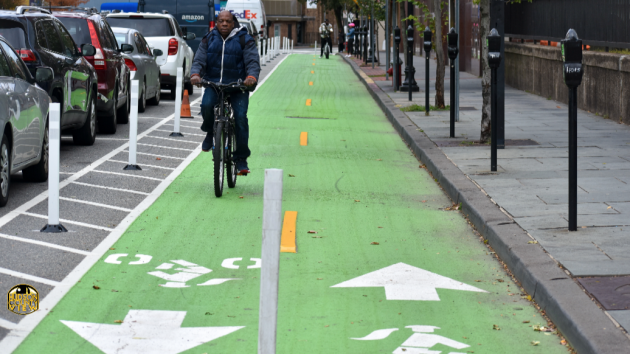
Two great examples lay right outside City Hall’s doorstep. Temporary barriers were recently installed to reinforce the Grove Street bike lane as a permanent solution awaits roadwork.
If the city can paint a Pride crosswalk every year, they can paint and repaint traffic calming measures on roads during and after sewer maintenance.
I trust the experts in City Hall can deliver recommendations on measures that can immediately improve street safety. Is it lowering speed limits across the city? Adding speed bumps? Adding more crosswalk signals and lights?
New Jersey state law currently bans use of speed and red light cameras, but other states and municipalities have seen a benefit from their use.
A study published in the American Journal of Public Health found that “Speed cameras installed in an urban setting are effective in reducing the numbers of road collisions and, consequently, the numbers of injured people and vehicles involved in collisions.”
Our state representatives should introduce legislation to make it possible for Jersey City to enforce traffic laws with speeding and red light cameras.
This legislation should carry teeth: increased fines, driver’s license points and penalties, including speed-limiting devices in vehicles and license suspension for serious abusers. Fines collected should go back to the municipality to support safe streets initiatives.
There are valid concerns about data gathering and the malicious use of that data. To counter those concerns, the state’s Innovation Authority should develop proprietary traffic camera software.
We can’t call ourselves the Einstein Corridor and pretend we can’t deliver high-quality, iterative software development in the benefit of the public.
Anything beyond the status quo would make a meaningful difference in resident’s lives. But it’s time elected officials and bureaucrats use every measure available to them to reduce traffic fatalities.