
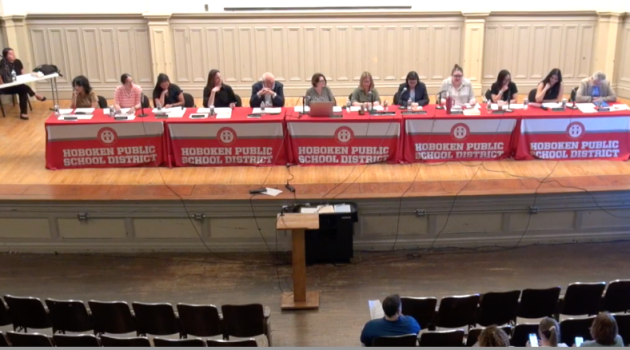
The Hoboken Board of Education (BOE) presented a revised $102,341,594 budget for the 2026-2027 scholastic year, which comes with a 23.6 percent tax increase, at a public hearing last night.

By Dan Israel/Hudson County View
“You will see there are some cuts, and I’m very excited for everyone to get an opportunity to see all the amazing things that are being accomplished in the world of public education here in Hoboken, New Jersey,” said Board President Ailene McGuirk.
“I think sometimes when peoples’ tax bills come in the mail, they think ‘Gosh, none of this benefits me’ … The reason that we live in the United States of America, and the reason we choose to live here and pay taxes, part of that is to live in a well-educated society … And public education is the driver for that. It is so incredibly important that we invest in our schools and in our children … and that’s what this budget this evening achieves.”
The tentative budget $104,848,035 budget with a 27 percent tax hike was approved unanimously back in March, as HCV first reported.
At the budget hearing, School Business Administrator Victoria Lopez presented the revised budget alongside members of the board, who chimed in with additional explanation as Lopez broke down the over $2.5 million in cuts they made.
She said the board considered cutting teaching staff but didn’t want to impact classroom sizes, making the similar decisions to avoid affects from cuts to co- and extra-curricular programs, athletics, special needs programs, and the facilities and maintenances budget.
According to Lopez, the over $102 million budget comes with a nearly $91.4 million tax levy, marking an increase of $17,450,629. This equates to a 23.6 percent tax increase, with the tax levy accounting for 89 percent of the budget’s revenue.
For a home with an average assessed value of $532,600, that will yield an additional $714.59 in property taxes per year, or $59.55 per month, or $1.96 per day.
“The budget we are presenting this evening, is a revised and refined version of the tentative budget that was introduced in March,” Lopez said.
“Since that time, we’ve taken a closer look at our assumptions, updated our figures, and made adjustments … At it’s core, this budget is the district’s complete financial plan for the 2026-2027 school year.”
According to Lopez, a significant portion of the over $102 million budget is driven by costs that are mandated by the state or contractually required such as special education services, employee benefits, and charter school tuition, while other portions reflect local decisions about programs and staff levels.
Of the tax increase, Lopez said benefits represented 32.6 percent, salaries represented 19.5 percent, and charter school payments represented 7.25 percent.
Of that $17.4 million increase, $12.6 million was identifiable cost increases with the remaining being the net impact of reduced revenue and the absence of a fund balance.
“This proposed total general operating budget totals $102,341,594 to educate the students of the district in grades kindergarten through twelfth grade, inclusive of certain preschool students in the disabled program or in inclusion settings with IEPs which totals approximately 2,900 students,” Lopez explained.
“And including those Hoboken residents attending charter schools, which is approximately 866 students. Collectively, approximately, 3,760 students.”
Lopez provided a summary of adjustments made by the board from the time of the tentative budget’s approval to now, including reductions in the local tax levy by $2,526,441; school-based budgets by $1,964,000; staffing costs by $848,698; health benefit costs due to staff reductions by $634,622; and community staff engagement by $195,593 – among several others.
The updated budgets also includes increases in: facilities maintenance and custodial allocations to address aging facilities by $385,999; allocations of payments-in-lieu-of-taxes (PILOT) payments by $200,000 for 770 Jackson Street; and Title I funds by $35,600.
During public comment, 1st Ward Councilman Paul Presinzano noted that the Hoboken City Council is also working to mitigate a double-digit tax increase, noting that they introduced a $152,128,410.25 municipal budget with a nearly 19 percent tax increase last month.
“The one core theme is that residents are just struggling with the fact that costs are out of our control as a message we give to them,” Presinzano declared.
“And that it’s not acceptable anymore … Their thought process is we’re electing to solve problems, and not give reasons. So, that core theme keeps coming up over and over with First Ward residents, and it’s not just only for the board of education, it’s for the city’s budget as well.”
According to Presinzano, while he understands that the district is “unhappy” about the PILOTs, he said he helped fight to include the school district in some of those agreements.
“We’re doing our part to try to help, because we know that the PILOTs sometimes are detrimental to many people in the education field,” he said.
“Going forward, if there is a PILOT, there’ll be a massive benefit for you guys in some of these facilities, which hopefully will allow you that overflow or the ability to move students and we can fix some of our aging facilities.”
Presinzano added that, as the First Ward undergoes redevelopment with more projects coming, he will fight for more school space as community givebacks outlined in the financial agreements.
According to McGuirk, the city’s total assessed property valuation is $12.2 billion, with nearly $1.75 billion of assessed property under PILOT agreements not contributing to schools, which she said was “not an insignificant number.”
“I support our school system wholeheartedly, but I do not support our school system blindly,” began 3rd Ward Councilman Mike Russo.
Russo echoed Presinzano that the council is also struggling to mitigate impacts on taxpayers in their upcoming budget, and took issue with the BOE tax increase, noting it would have made sense if the municipal and county taxes were not increasing.
“You’re looking at 23.5 percent here, you’re looking at almost 20 percent at the City of Hoboken, and you’re probably looking at 10 percent more from the County of Hudson,” he declared.
“To every resident in the city of Hoboken, overall you’re looking at an overall tax increase of about 18 percent if nothing else changes. That is not $700 a year. That is a lot more money.”
Russo said that while the school district, city, and county and responsible for their portions respectively, they need to look at the overall tax increase across the board when drawing up their budgets.
He also disagreed with the board’s financial analysis especially of PILOTs, arguing against the idea that they increase the burden on local taxpayers.
Meanwhile, the board feels that due to PILOTs, the pool of taxpayers remains the same, while the student body and city population grow.
“I understand your struggle with that, but when you look at the totality of the tax increase, a PILOT actually decreases the burden on the individual Hoboken taxpayer because we get more money that the county is not getting from a PILOT,” Russo continued.
“And that’s a dispute, and I understand that. There’s two different ways of looking at it.”
Russo urged the board to look at its budget again to reduce the tax increase further, like leaving the State Health Benefits Plan since Hoboken’s younger, healthier population is paying for older, sicker populations across the state.
Other Hoboken residents like Barry Grossman and Manuel Rivera Soler also expressed their desire for the board to make further adjustments in the budget to reduce the tax increase.
While 2nd Ward Councilwoman Tiffanie Fisher and 6th Ward Councilwoman Diane Imus were present in the audience, they did not address the board during the public session.
The school board took no formal action at last night’s meeting.