
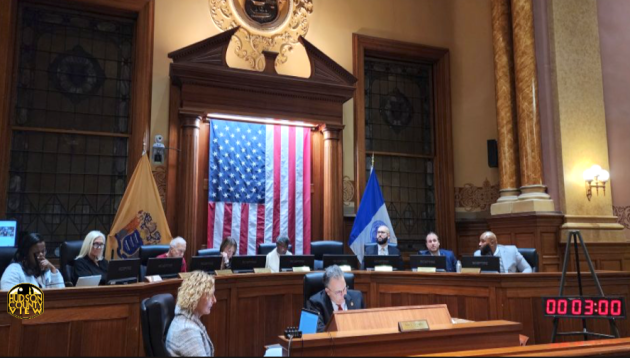
In an editorial, Jersey City resident Eric Allen Conner gives his take on why last week’s city council meeting was a bad night for housing and affordability.
Jersey City, like many coastal cities, is in the midst of an urgent housing shortage that is driving up prices and accelerating gentrification. The national vacancy rate is 9.6% but in Jersey City only 5.8% of units are vacant at any given time. Housing is in short supply.
And it’s a shortage that can only be relieved by enabling more housing supply to be built. Unfortunately, the final city council meeting of the year was a rough one for housing affordability in Jersey City:
• An ordinance that would implement master plan recommendations to allow more mixed-income housing along Route 139 (within walking distance of the Journal Square PATH station) was tabled in a 6-1 vote;
• A resolution that would have authorized the city’s planning department to study a proposal for mixed-income housing at 150-156 Bay Street was voted down unanimously; and
• While the city council did not overturn Mayor Fulop’s veto of Ord. 25-123 (required bird-safe glass in all new construction, renovations, and additions citywide), Councilman Solomon vowed to reintroduce the ordinance when he takes over as mayor.
There is a terrible double standard when it comes to housing policy decisions in this city.
Our elected leaders give little thought whenever they are asked to enact a new rule that will make living here more expensive. Sadly, they never seem to have the same urgency when given the chance to enact policies that improve affordability.
The continuing controversy around the bird-safe glass ordinance illustrates the point perfectly.
Community activist Tina Nalls (who came in fourth in the at-large council election this year) had a dramatic display when she tried to present a bird’s eyeball as part of her testimony in favor of the bird-glass ordinance that could raise construction costs by 5% citywide.
Proponents of the bird-glass ordinance claim they aren’t opposed to new housing construction, yet earlier this year Nalls campaigned on freezing housing development (even if it included affordable housing), which would have disastrous consequences for affordability.
The city council is lightning fast whenever it comes to a plan to make housing more expensive if the idea sounds well-intentioned enough. The bird glass ordinance was introduced mere months ago by Councilman Solomon.
The council passed it unanimously, but did not commission a study to determine the extent of the problem, did not do due diligence on any of the activists’ assertions, and did not conduct a thorough analysis on the costs or benefits of the legislation even after it became apparent it was much more expensive than advocates had claimed.
No city has ever been made affordable by making new housing more expensive to build. Policy making in this city truly appears to be for the birds, not the people.
By comparison, whenever our planners propose to modernize our zoning laws to make it easier to build housing, activists demand countless presentations to their local neighborhood associations, followed by resolutions authorizing studies that include lengthy review processes that may (or may not) eventually result in the city council amending zoning to build more housing in some small redevelopment area.
The city council carefully considers every objection whenever a group shouts, “Not in my backyard!” loud enough.
We give extreme deference to wealthier NIMBYs who own brownstones and luxury condos at the expense of renters and households struggling to make ends meet.
And politicians happily traffic in manipulative populist rhetoric, blaming “greedy developers” and indulging in folksy but false wisdom about new housing making existing housing more expensive.
It took over four years of planning and study to get the Route 139 upzoning before coming before the city council for approval.
In those four years, the plan was amended several times, eliminating much height and density along the way even though that density is already allowed across the street.
That means fewer homes, more competition for existing homes, higher rents, and more displacement. And, despite these concessions, the zoning amendment was delayed yet again last week.
Later that same night, the council unanimously rejected a resolution for planning to merely study a plan to put about 1,000 new apartments (150 affordable) and a new school at 150-156 Bay St. after Kathryn Moore from the local neighborhood association and three condo owners in the nearby Oakman building complained the proposed high-rise might alter their million-dollar views.
As New York’s mayor-elect Zohran Mamdani has stated repeatedly, the only path to real, widespread housing affordability is to build more housing.
So what did this council meeting potentially cost the people of Jersey City?
Upzoning 139 would eventually help lower rents in the surrounding community, restore walkability, and stitch the Heights and Journal Square closer together.
The 150 Bay Street plan would directly house 1,000 families and help 150 households get off the ever-growing, decades-long affordable housing waiting list and build a much needed school.
And, beyond that, according to multiple academic studies, those thousand new apartments would have freed up 700 older rental units in the region, creating more affordability as people move into new homes. Affordability, apparently, can always wait.
As the current political era comes to a close, I am not optimistic for the future of housing affordability in Jersey City.
Despite overwhelming evidence and near universal consensus among economists that increasing new housing supply makes older housing nearby more affordable, Jersey City is increasingly moving to make housing scarcer by making housing construction slower and more expensive.
Rents will increase, and long-time residents will be displaced.
If we truly want a Jersey City that families of diverse economic backgrounds can afford, then people need to show up and speak out in favor of building more housing.








Boo-hoo, developers have 5% less money to add to their mountain of cash.