
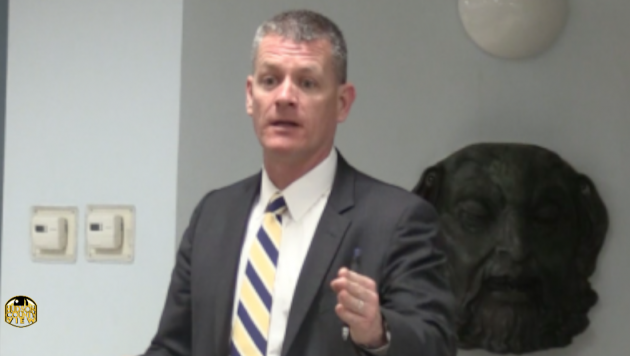
In a letter to the editor, Jersey City Police Superior Officers Association (PSOA) President Capt. Pawel Wojtowicz gives his take on why the department “did not grow or improve” under the leadership of Public Safety Director James Shea.
 Dear Editor,
Recent statements from outgoing Mayor Fulop regarding the resignation of Public Safety Director Jim Shea—such as, “Jim Shea restructured the police department, hired and promoted more officers than any chief before him, led Jersey City through a mass shooting, and helped deliver the lowest homicide numbers in our city’s history.”
“He ignored politics, focused on results, and made Jersey City safer”—could not be further from the truth.
After the mayor’s recent remarks praising James Shea’s job performance, I would be neglectful if I did not speak on behalf of the men and women of the Jersey City Police Superior Officers Association and the residents of this city.
Jersey City police did not grow or improve under his leadership. In fact, one could easily argue that James Shea set the department—and the community it serves—back significantly.
Director Shea ruined one of the best police departments in this state.
His ego-driven, micromanaging leadership style led to the closure of the motorcycle squad, wasting millions of taxpayer dollars by allowing Jersey City Police motorcycles to sit unused and deteriorate, while simultaneously touting the department’s commitment to Vision Zero.
He shut down a long-standing off-duty program because of the actions of a few officers, punishing hundreds in the process. Director Shea also allowed New Jersey State Police to work paid details in Jersey City instead of JCPD officers who are familiar with—and come from—the neighborhoods they serve.
He frequently touted the department as the most diverse in its history, yet paid current officers less—when accounting for inflation, rising healthcare costs, and the elimination of longevity—than officers were paid twenty years ago.
New hires were moved to inferior medical coverage, OMNIA co-pays were quadrupled, and already uncompetitive salaries were further eroded.
Millions of dollars were wasted on frivolous litigation with nearly every public safety union, largely due to ego-driven violations of contractual agreements.
The Jersey City Police Department was once a sought-after agency for career advancement.
Under Director Shea’s authoritarian leadership, officers now leave for other departments immediately after graduating from the academy.
When Director Shea assumed control, JCPD had 769 officers in 2013 serving a population of roughly 240,000 residents. Today, with a population exceeding 300,000 residents, the department has only about 794 officers.
The department is losing more officers to resignations than to retirements, and dozens of current JCPD officers are actively testing on surrounding municipalities’ civil service lists due to better pay, benefits, and working conditions elsewhere.
Officers are not leaving the profession—they are leaving JCPD due to poor morale and gross mismanagement. Officers are routinely required to attend training on their own time, along with other mandates that have nothing to do with professional development and serve only as punitive measures.
Despite repeatedly claiming there was “no money” for the police department, Director Shea operated from the top floor of a $200 million Public Safety Headquarters with sweeping views of his former employer.
Meanwhile, the East District has been forced to operate out of temporary trailers for nearly three years, a clear symbol of misplaced priorities.
Most egregiously, Director Shea repeatedly misled the governing body during caucus meetings.
The City Council got it right when it supported a vote of no confidence; unfortunately, it came too late—after Director Shea collected an annual salary of approximately $250,000 for over a decade.
In stark contrast, Mayor-Elect Solomon and his staff have already communicated more effectively and transparently with rank-and-file officers than either Director Shea or Mayor Fulop ever did.
I only hope that another municipality does not make the same mistake by hiring James Shea and allowing him to ruin its police department as he did in Jersey City.
Pawel Wojtowicz
Jersey City PSOA President






You’ve been head of PSOA for years. It’s not brave to write a letter like this when he leaves – should have done it earlier.
This pig spent a lot of time writing op-eds about how awful Solomon would be for cops and now he’s changed his tune because the MAGA chud he wanted to cut his checks lost.
Hey all, I guess I’ll chime in bc this convo touches me also. Hope it’s taken respectfully and the negative comments stop about the initial letter and people pay attention to the real agenda at hand and not your personal feelings on the initial writer. Let’s be adults, (hopefully), and save the harsh words for anyone face to face. Anonymity makes everyone brave I see. That bravery will get us further from the problem addressed.
I am a lifelong Chilltown resident and taxpayer, and I write this with intimate knowledge of the Jersey City Police Department through past and present family members who have served within it. I also hold a bachelor’s degree in business administration, which shapes how I view municipal budgets, labor markets, compensation sstructures, and the difficult tradeoffs city leadership must navigate. I want y’all to know my perspective is not emotional or reactionary. It is grounded in both lived experience and an understanding of how public systems kind of function.
At the outset, I want to be clear that this is not a response bashing Public Safety Director James Shea or Mayor Steven Fulop. I am genuinely appreciative of the emphasis on diversity, recruitment, and hiring that occurred under their leadership. Those efforts matter, and they have had a positive impact. However, as Captain Wojtowcz of the Police Superior Officers Association stated, we cannot meaningfully celebrate hiring while simultaneously stripping away what historically made officers stay. That tension sits at the heart of today’s morale and retention challenges.
As a taxpayer, I have also experienced the real-world consequences of understaffing. Without naming an incident or individuals, my household was involved in a life-and-death emergency where police response exceeded twenty minutes. I am not alleging neglect, nor am I claiming to know what other high-priority calls were occurring at the time. What I learned afterward, through conversations with members of the department, is something many residents never fully understand: each district has a limited number of cars, and when those units are committed to other priority calls, there may simply be no immediate availability.
Now that is not an individual failure. But it is a structural one.
Jersey City has grown denser, more complex, and significantly more expensive. Yet many officers cannot afford to live in the city they serve from what I hear and see. We continue to approve major residential development while the people responsible for responding to emergencies are increasingly priced out of our neighborhoods. At the same time, officers’ financial stability often depends on extra-duty work that fluctuates dramatically. One period it is abundant; the next it is scarce. That kind of instability does not foster focus or long-term commitment. It breeds stress, fatigue, and attrition.
We also need to be honest about expectations. Residents rightly expect professionalism, restraint, empathy, and sound judgment under pressure. Those expectations are fair for us. But is not fair in demanding elite performance while compensation, staffing, and training lag behind neighboring departments and the region’s cost of living.
This is not a call for reckless spending. It is a call for alignment.
If we expect faster response times, better community engagement, and higher standards of conduct, then compensation, staffing levels, and training must reflect those expectations. Recent labor agreements were an important step forward, but they were corrective in nature. They addressed how far behind officers had fallen when adjusted for inflation, healthcare costs, and longevity changes.
Training must also be part of this conversation. Not just mandated training, but meaningful professional development that improves communication, judgment under stress, emotional awareness, and leadership. Passing exams and memorizing laws does not automatically produce strong supervisors. Departments improve when leadership invests in people as professionals, not just headcount.
This brings the conversation to leadership and the future.
This letter is ultimately an appeal to incoming Mayor Solomon. I am encouraged by reports of open communication with police, fire, and public safety stakeholders. Leadership matters. Policing, like any organization, reflects the priorities set at the top. The quality of a police department is often a direct reflection of the quality and clarity of its leadership.
My brother (R.I.P.) loved Deion Sanders’ quote and quote it all the time and smile! “When you look good, you feel good. When you feel good, you play good, and when you play good, they pay good.” Policing works differently. In law enforcement, investment comes first. Officers are trained, equipped, supervised, and compensated by the city before results ever reach the community. When that investment is insufficient, even good officers become frustrated, burned out, and eventually leave. We hire them, train them, place them on what amounts to a rookie contract, and then act surprised when they transfer to departments that offer better pay, stronger training, and clearer support. If my J.C. wants long-term results, retention, and safer outcomes, it must treat pay and training not as rewards after performance, but as prerequisites for it.
As an on time taxpayer, business owner, and landlord, I am willing to support paying our public servants better if it results in better service, faster response times, and a safer city. Accountability cuts both ways. Higher compensation should come with higher expectations. That is not anti-police. It is pro-public safety.
Jersey City deserves a police department that officers choose to stay in and residents can rely on when it matters most.
God Bless our officers, troops, firefighters, and all who give a lil extra.
Respectfully, “Pretty L”
Give the Jersey city police back their moonlighting jobs bring back the motorcycle squad and the mounted police!