Hoboken’s Camera-based License Plate Enforcement for Access & Response (CLEAR) program will remain in tact after the city council voted 4-4 to halt it, meaning the resolution failed, at Wednesday’s meeting.
By John Heinis/Hudson County View
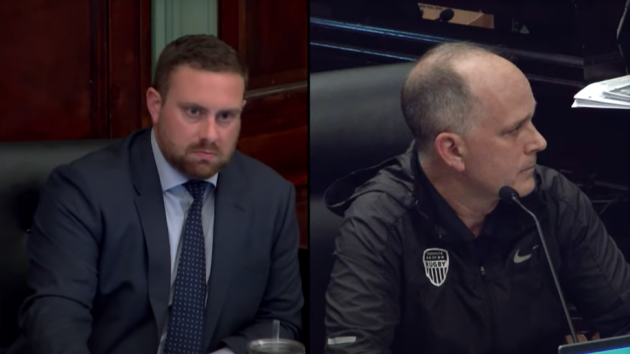
“I don’t see Director [of Transportation and Parking Steven] Weber, correct? Get ready to get in the hot seat [Business Administrator] Caleb [Stratton]. There’s a lot of questions, you might want to loosen your tie a little bit there,” began 1st Ward Councilman Paul Presinzano.
He along with 2nd Ward Councilwoman Tiffanie Fisher and 4th Ward Councilman Ruben Ramos, both mayoral candidates, sponsored a resolution to pause the CLEAR initiative after business owners complained that it was having an adverse effect.
“I’ve asked for a briefing, and I think you’ve been on some of those emails, and you’ve told me I’ll get a briefing on the CLEAR program. Now, it’s already been instituted and I haven’t received that, one. Two, the businesses definitely haven’t been included in this because they’ve all stated that tonight,” Presinzano continued.
The downtown councilman said that the traffic on Washington Street has been as dead as it’s ever been around 4:30 p.m. ever since the program began on October 1st.
He also noted that Ernie Reyes, the owner of Ace Hardware located at 130 Washington St., said during public comment that his business has declined 10 percent since the CLEAR program started to deter illegal parking.
He then began to press Stratton on how the program came to be, asking if the program was ever announced to the public in a Nixle alert, to which he said he was not sure, and then questioning if the council was briefed before the public alert.
“Yes,” Stratton replied.
“Who, because I didn’t get any alert. No, that’s a lie: Sorry,” Presinzano quipped back, trying to continue before Stratton interjected.
“Don’t impugn by integrity, I’m giving you honest answers to questions that you didn’t provide me with before the meeting. The council was briefed on this program. The council was provided information during subcommittee, and to the best of my knowledge, this program, in its rollout, was made available to the council,” he asserted.
Stratton added that he would admit he was wrong if proven wrong, to which Presinzano reiterated that Weber or someone from the Department of Transportation should be answering these questions.
After Presinzano apologized for being hostile, he asked if the study was based off of raw data without performing any sort of economic data, to which Stratton said that was his understanding, then asking if this was originally for a loading zoning study or not.
“The materials that I saw from the contract authorization included a loading zone study, a number of different elements related to violations and on multiple different sections of it, there was always enforcement that was contemplated as part of the Phase 2 rollout.”
Stratton then answered that it was Mayor Ravi Bhalla’s call to begin the enforcement phase of the program on October 1st.
“President Doyle, I would ask, it seems out of the transportation subcommittee or the transportation committee in general, department, that there’s been some massive stuff that’s come out of there that we are just not briefed on here,” Presinzano declared.
“And I believe I touched on this earlier in the year, asking for us as subcommittee chairs to get reports because if this was presented to the subcommittee, this could’ve been nipped in the bid because we could’ve given input on this if we’d known about it. I found out, as well as my businesses in the 1st Ward … the Nixle alert is how I found out about it.”
3rd Ward Councilman Mike Russo, another mayoral candidate, said his interpretation of a memo from Corporation Counsel Brian Aloia is that the city council was supposed to set the procedure to allow for cameras to issue automated traffic tickets.
“You didn’t really address if the city council did that, now I’m assuming, in my memory, that we’ve never done anything allowing automated enforcement. As a matter of fact, contrary to allowing any automated enforcement, we have a law on the books that prohibits automated enforcement when it comes to traffic violations.”
Councilman-at-Large Joe Quintero disagreed, reminding everyone that this is a pilot program and sometimes going live to test data is the only way to gather information.
He added that the goal here was to clear up the bike lanes (no pun intended), citing data the mayor released on Tuesday evening, declaring that parking violations are down 52 percent in the first week of the program, as HCV first reported.
” … We’ve been seeing, and the data showed this before this started, that people were parking in the loading zones for hours, not just 20 minutes. So that hurts all of our businesses, if there’s regular turnover in our loading zones, they’re gonna have more opportunities to load and unload their trucks at their locations, but there might not be enough loading zones to support the businesses,” said 5th Ward Councilman Phil Cohen.
“Maybe double parking has been so relied upon for so long, that the loading zones that we have simply do not accomodate the needs of the business community and we need to adjust. We’re going to get the data to draw those conclusions and make those changes.”
Fisher noted that a year-and-a-half ago when the council voted 8-1 to advance the program (Ramos voted no), the entire conversation revolved around being to use the cameras “to potentially create 15-minute drop off/loading zones on Washington Street, which we’ve not been able to have.”
She further stated that then-Parking Director Ryan Sharp made a compelling case for the aforementioned zones and the council was assured to have a seat at the table for when the program rolled out.
” … This is the administration, for some reason unbeknownst to all of us except Team Bhalla, they had to rush in in the busiest time of the year for most of our businesses,” Fisher stated.
“When I sit here and I listen to my colleagues up here after they sat and heard from businesses, who said they weren’t listen to, who said they weren’t considered, who said they weren’t approached to even to discuss the potential impact, to listen to my colleagues just basically say ‘your voice doesn’t matter right now … I could not disagree more with Councilman Quintero saying we can’t plan for everything …”
The measure ultimately failed 4-4, with Presinzano, Fisher, Russo, and Ramos voting yes, while Councilwoman-at-Large Emily Jabbour, Quintero, Cohen, and Council President Jim Doyle voted no.