Hudson County has formed a team of election staff to ensure dead residents of Hudson County don’t vote, according to Superintendent of Elections and Commissioner of Registration Maryanne Kelleher.
By Dan Israel/Hudson County View
Kelleher said that in the two years she has been in the role, the Hudson County Decedent Team was formed specifically to prevent the deceased from exercising their former civic right to vote from beyond the grave.
The revelation came during the the first public hearings for the 2026 county budget totaling over $769 million, of which the final hearing is today at 6 p.m. during which the public can comment.
“I think it was Brenden Byrne who said ‘When I die, I want to be buried in Hudson County so that I can stay active in voting.’ We know it’s funny, buy it’s really not that funny and we want to get away from that idea,” Kelleher said.
Colloquially, the county has been the punching bag for corruption and other criminal-related jokes, often also levied against local Democratic politicians.
However, Kelleher is among other Hudson County officials who want to end that perception that makes the county the punch line of political jokes from across the state and beyond, which is why she made it a priority to form the decedent team.
Every single municipality in Hudson County is required to notify the county of a list of people who died the month prior, but some municipalities were in arrears and were backlogged, she said.
When that occurs, the decedent team is responsible for reminding town clerks or health officers that the list is due each month.
According to Kelleher, the lists come in digitally now – no longer via snail mail – and the county deletes the names on the list within a week’s time.
The decedent team has also scheduled a meeting with the Hudson County Funeral Directors Association with the intention of adding them to their email list so that they could provide families with the service of filing out a decedent voter removal form.
“That way we can take pride in our voter rolls in Hudson County. That’s a real value of mine, because when you’re the superintendent, you don’t want to hear the jokes about dead people voting,” Kelleher reiterated.
She further stated that she tried to make more “straight lines” for employees to advance from within – including forming the decedent team which saw existing employees assuming some of those responsibilities already.
Additionally, she said she also conducted an entire audit of elections records as the New Jersey State Division of Elections changed their archiving schedule.
Kelleher said this included upgrading the archiving space with counter spaces for investigators, specifically for them to count provisional ballots in one secure location.
In addition to shredding old documents amid digitization, she also noted how the Office of the Superintendent of Elections has further immersed in modern technology by ensuring all employees have a dedicated phone line.
Kelleher described other ongoing updates to the her office as including a dedicated budget tracker to ensure timely reimbursements from the state for early voting, and the completion this year of the process of “barcoding” all digital elections equipment as part of asset inventory management.
“When all of our important elections equipment leaves the warehouse, it will be scanned on the way, scanned upon return .We know where our equipment is. We know where it is right now with people power, but this improves efficiency and meets the demands of today,” she explained.
On top of that, Kelleher said they have started to train on election response, which has been slower since not all employees are proficient yet with technology.
Thus her office has been doing a lot of cross training, but regardless an elections investigator at a polling place is now able to ping Kelleher and other staff through a tablet if something has gone wrong to immediately deploy a voting machine technician.
Additionally, she stated that they have also been bolstering field investigations for elections investigators, who have police powers to enforce Title 19 violations but are usually prompted by returned election mail.
They also are responsible for identifying voters in certain circumstances, sometimes opening investigations as a result.
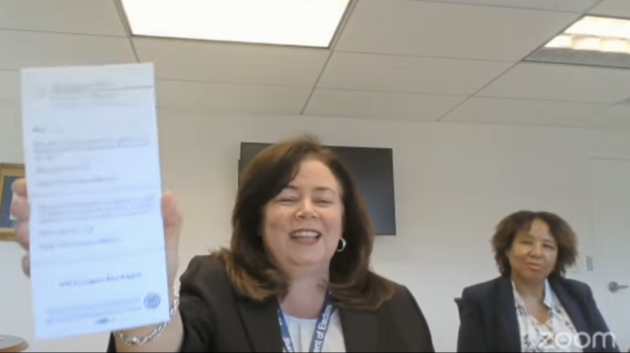
Further, Kelleher was proud to show off the new way of notifying voters if an investigator went to their address and they weren’t home: papers designed to stick to doors- akin to “Sorry we missed you” notices from UPS – informing residents to reach out to the investigator who stopped by earlier that day.
“In a perfect world, a ballot goes out and it should come back to us if they can’t reach the voter. But sometimes it doesn’t. And we can’t just blindly delete people from the voter rolls.”
Kelleher added that investigators and election deputies are equipped with clipboards for polling place oversight, stating that although they do not hire poll workers, which the Board of Elections is responsible for, but they do support them.
Their observations then become part of post-election reports that Kelleher has initiated to the Board of Elections.
“When we go into the field and encounter a poll worker problem, maybe a deficiency, or even if you know we have a great poll worker situation, we are documenting that and providing post-election reports to the board to help them identify places where we maybe need support.”
In addition, Kelleher said that her office also finally published prior to the presidential election in 2024 a poll worker manual after operating without a recent one for years.
Last year, she said that two newer employees who are “good with technology” met with an employee who has been working at their elections warehouse for over 40 years, and utilized his assistance to write and publish an early voting poll worker manual as well.
“It’s gotten a lot of positive response from voters and poll workers alike. This is how we help people give people active manuals to work today,” Kelleher added.