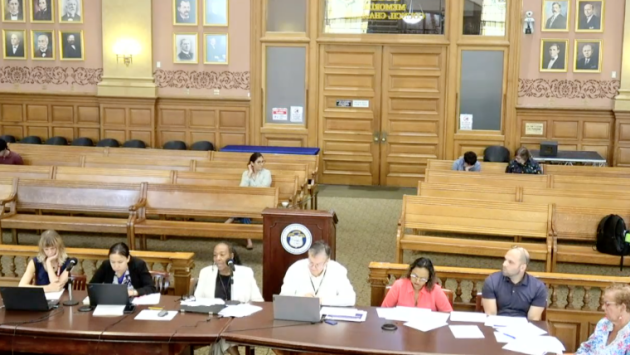
Jersey City Department of Health and Human Services (HHS) Director Linda Ivory-Green laid out the nearly 35% funding cuts proposed for their $8.2 million budget at yesterday’s hearing before the City Council.
By Dan Israel/ Hudson County View
“Health and Human Services serves as Jersey City’s local public health authority. Our responsibility is protect the health, safety, and well-being of more than 300,000 residents through an integrated network of public health, environmental health, human services, nutrition programs, emergency preparedness, animal care and control, regulatory oversight, and grant-funded initiatives,” began Director Linda Ivory-Green said.
“Our work is rooted in prevention. Success in public health is often measured in what does not happen, the crisis we sort of avert, diseases that are prevented, outbreaks that are contained, environmental hazards that are corrected, and children who avoid lead poisoning, seniors who remain health and independent, and residents who receive help before a crisis occurs.”
Discussing the scope of the department and the residents it is responsible for serving, Ivory-Green said core service areas include state-mandated functions – which are not optional municipal service s- such as the divisions of: Community Health and Wellness, Communicable Disease, and Environmental Health.
“These functions ensure that the places where residents live, work, learn, and eat are actually safe,” Ivory-Green said.
Other divisions under the HHS Department include, Human Services, Food and Nutrition, Animal Care and Control, as well as Grants and Partnerships.
“Although each area has distinct responsibilities, residents often need more than one service. Our responsibility is it improve coordination so that residents do not have to navigate government in fragments,” stated Ivory-Green.
According to Ivory-Green, HHS this year has secured $8.4 million in grant funding across 21 programs supporting nutrition, disease prevention, environmental health, and behavioral health.
“This funding allows Jersey City to provide services the municipal operating budget could not sustain on its own. It also demonstrates that we’re sort of actively leveraging some outside resources as opposed to depending solely on city dollars,” she added.
In addition, Ivory-Green touted how HHS: launched the Mental Health Crisis Intervention Committee to unite healthcare, law enforcement, education, and community partners around crisis response; expanded homeless outreach; and enhanced management, procurement, and financial monitoring while advancing restructuring to cut duplication and identify long-term savings.
According to Ivory-Green, the total HHS draft budget tallies $8,206,222, consisting of $6,561,387 in salary and wages and $1,644,835 in operating expenses.
This was a reduction from the departmental request of $12,589,087, of which the original ask included $8,691,736 in salary and wages and $3,897,351 in operating expenses.
Salaries and wages compose 80 percent of HHS’s budget, as opposed to 20 percent being operating expenses.
As such, salaries and wages were reduced by $2,130,349 by 24.5 percent, operating expenses were reduced by $2,252,516 by 57.8 percent, and the overall HHS budget was reduced by $4,382,865 by 34.8 percent.
“A reduction of this size is just not absorbed through minor administrative adjustments alone, it affects contracts, supplies, program capacity, response flexibility, and our ability to address emerging needs,” Ivory-Green said.
She also noted she was responsible for managing with the budget and ensure services for residents are maintained, along with the fact that personnel savings largely came from eliminating positions, resulting in critical vacancies remaining.
She said due to reductions in salaries and wages in the HHS budget, their responsibilities have been redistributed, operational capacities and hours have been reduced, as the available staff copes with new operational priorities.
However, she said crush training can only support some of the continuity at HHS but doesn’t replace the capacity, time, and experience by those positions that are no longer with the department.
Regarding the eliminated vacancies, HHS seeks to fill them as funding permits as a number of those vacancies are grant-supported or required to meet state regulatory, programmatic, and public health service standards.
Thus, permanent elimination may limit the department’s external funding capacity.
A proposed reorganization would reduce management expenditures through division consolidation and reclassification of certain leadership roles, and would balance immediate budget reductions against long-term service delivery and regulatory obligations.
Taking a “recurring savings, preserved capacity” approach seeks to generate savings while retaining the organizational capacity to restore critical positions as grant funding and operational demands evolve.
Ivory-Green later stated that operating expenses support the practical cost of delivering services, including contracts, supplies, equipment, transportation, program materials, technology, facilities, professional services, and other expenses for the department.
“We will continue to prioritize legally-required health and safety-related and mission critical expenditures, however a reduction in more than half limits our flexibility, affects program reach, and reduces our ability to absorb unplanned costs or respond to changing conditions,” she expressed.
The lack of ability to replace employees has translated to reduced staffing and hours, like licensing is by appointment only, senior affairs trips have been cut for out-of-town being in-town only now, and the city clinic has eliminated evening hours.
According to Ivory-Green, in personnel, the department has already eliminated vacant positions where feasible, absorbed duties through existing staff, transferred staff to fill gaps instead of hiring, reduced overtime through workload management, and adjusted and reduced operating hours to staffing levels.
In programs, she said they consolidated overlapping program functions, reorganized operations, moved to integral cross-divisional service models, and leveraged community partnerships for delivery.
And on contracts and operating costs, Ivory-Green said she reviewed contracts for cost-saving opportunities, eliminated unnecessary expenditures, reduced discretionary spending, prioritized spending on critical public health services, and pursued grants.
“Going forward, we will continue to evaluate our shared services, regional partnerships, and management consolidation. But efficiency does not mean every eliminated function can be absorbed indefinitely without affecting workload, timelines, and service capacity,” she declared.
HHS has pursued nearly $1.09 million in new funding through 8 local, state, and federal grant applications since the start of the Solomon Administration, including for chronic disease self-management, preventing drug overdoses, violence and behavioral health, among many other things, Ivory-Green said.
She added they are also examining joint grant applications with the Department of Public Safety.
“We do have deliberate strategy to align outside funding with all our core activities and our public health services. That is what our strategy is,” Ivory-Green said.
Looking ahead, that director indicated that HHS is looking to establish an Office of Social for outreach, case management, resource navigation, and coordinated supportive services under one roof.
She also wants to create new revenue through proposals in development to offset the cost of public health oversight, such as pool licensing, food truck zone expansion with enhanced fees, and regional animal control services.
In addition, Ivory-Green outline what she called “a continuum of care” for the chronically homeless consisting of “prevention, outreach, crisis, stabilization, transitional housings and pathways to permanent supportive housing.”
It was also stipulated that a dedicated HHS finance team will strengthen fiscal oversight, grant management, budget monitoring, and procurement across the Department’s expanding portfolio.
Despite the challenges, Ivory-Green remained optimistic that HHS can continue to deliver for its staff and residents even at the reduced operational capacity.
“Above all, our work will remain guided in health equity,” Ivory-Green said, calling public health both an essential service and strategic investment.
“Every decision that we make should help reduce barriers, improve access, and create healthier outcomes in every neighborhood of Jersey City.”
Though the council cross-examined Ivory-Green over her presentation and went line-by-line through division budgetary line items, they ultimately set a second budget hearing for HHS in the future.