The Jersey City Council reviewed the roughly $9.21 million Housing, Economic Development & Commerce (HEDC) budget this afternoon, seeking new revenue streams from construction code enforcement and much more.
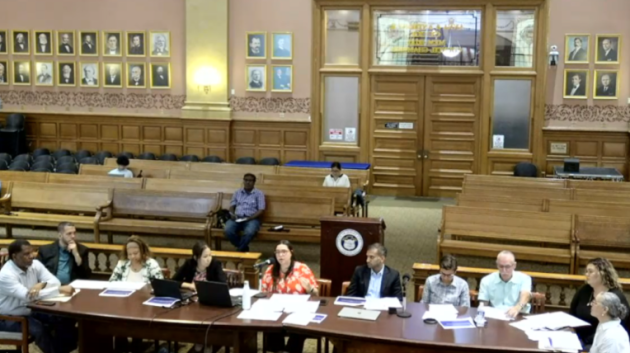
By Daniel Ulloa/Hudson County View
The HEDC proposed operating budget for 2026 is approximately $9.21 million after generating about $34 million in revenue last year.
“Our revenue is like a 4-to-1 return to the city,” HEDC Director Annisia Cialone began.
She further explained that there are 13 entities and nine boards in their budget covering commerce, economic development, affordable housing, housing preservation, construction code, and business support, among others.
Cialone added that there are nine divisions with a total of 134 employees in the HEDC, along with the land use boards of Planning, Zoning, and the Cannabis Control Board (CCB).
She continued that the Commerce, Construction Code, and Housing Preservation departments generated most of their revenue in 2025, also honing in on specifics such as $936,000 was collected by the Affordable Housing Division last year.
Also, the Construction Code Office generated $9 million in 2025, with the Housing Preservation Enforcement and Revenue division making about $10 million on a $1.8 million budget. That came through the Hotel Occupancy Tax, which generated $8.75 million.
According to Cialone, landlord registration fees generated $581,000, vacant and foreclosure fees made $332,000, while short-term rental fees produce $188,000.
Cialone explained that the commerce department is collecting more money with a parking lot fee, a mass transit fee, ABC licenses, and the cannabis business tax.
She also noted 90 percent of their department is personnel salaries, while 39 percent of their revenue is generated by the Construction Code Department.
Regarding this year’s budget, she said five positions have been eliminated this year and six were lost last year, a total of about $800,000 was cut. Cialone also noted that their budget was $10 million in 2024.
“We’re trying to do the most we can with the smallest budget … We’re always looking for grant opportunities,” Cialone explained, adding that they’re looking to raise fees on construction code, billboard licensing registration, driveways, and parking lots.
Ward D Councilman Jake Ephros asked about the Director’s Office contracts.
Cialone said they have a LexisNexis subscription to research laws, which is a large part of it.
Ephros replied that the Law Department also has an expensive LexisNexis account and wondered if there may be ways for them to collaborate.f
“I would be happy to see if there’s cost savings there,” Cialone replied.
Ward B Councilman Joel Brooks than asking how they could hold developers accountable for further revenue generation.
“One of the things we’ve heard from the public is … wanting to hold developers accountable, wanting to hold bad actors accountable, and that could generate revenue through summonses,” Brooks explained.
“We’re not gonna see that revenue from either fees or from violations, that’s not offsetting your budget?”
She said that was correct and they could break down the revenue HEDC is brining in, though noted tickets would show up in the municipal court budget.
“So according to state statue, the revenue that comes into Construction Code is supposed to reside in that jurisdiction. Can you confirm or deny it?” Ward F Councilman Frank “Educational” Gilmore asked, which Cialone confirmed was accurate.
“All of the money generated via construction code is supposed to go back into that office?” Gilmore pressed.
“It’s not a dedication by rider … but the DCA (New Jersey Department of Community Affairs) does want to see you’re investing in the Construction Code office. It’s a guideline … not a restriction. Council still has jurisdiction,” she added.
Construction Code Official Joe Severini then sought to provide further clarity.
“Our fee schedule is set up to only make enough money to run the department. We haven’t changed our fee schedule in over 20 years because we’re making way too much money and the state would never allow it,” he explained.
“They want to see us invest in the department with the funds we’re collecting.”
Gilmore said he understood, but felt like a more “comprehensive plan” was in order.
“Just waiting on inspections, it seems like it’s taking forever. But if we have the opportunity to hire from the money generated by that department, that’s a no-brainer,” he expressed.
Brooks then asked about Housing Preservation and short-term rental enforcement.
Cialone said they have a good relationship with Airbnb after they worked with the Law Department, which has led to a steady stream of revenue from taxes and registration fees, noting that she wished they had a similar relationship with Vrbo.
“It cuts down on the enforcement issues because you can’t even post your property unless you’re registered with the city,” Cialone said.
“With Uber, if you’re not a New York resident, you can’t register there. Is there any way we can do that with these platforms who are not in agreement with Jersey City?” asked Councilman at-Large Michael Griffin.
“If they don’t want to agree on our terms, they shouldn’t be allowed to participate,” he argued.
“That’s something we would have to talk to the Law Department about,” Cialone said.
Ephros then asked if they could get a sense of the long-awaited rent control audit report.
Cialone said Division of Housing Preservation Manager Johna Noel is leading the effort.
Phase 1, which is an inventory of properties, will be released soon, she said. Phase 2 is an inventory of documented rent-control exempt properties, Phase 3 is the tenant notification phase, and expanding efforts, and Phase 4 is to establish the base rents for rent control tenants.
“Some of those phases do need external help,” Cialone added.
Noel said they’re reviewing property records from the 1980s and 1990s. She explained that sometimes new property owners don’t think they’re subject to it, or new owners are unaware of rent control laws.
“We’ve been issuing summonses to landlords who have not complied,” she declared.
“What are the staffing needs that are out there? Would additional staff generate revenue to cover the costs itself?” Ephros asked about the Landlord-Tenant and Preservation Office.
“I wouldn’t say the budget reflects what they hope or want to do,” Cialone said.
Additionally, Ward E Councilwoman Eleana Little asked why former Mayor Steven Fulop’s Deputy Chief of Staff Phil Orphanidis, who pleaded guilty to refusing a breathalyzer last month, was still included as part of their budget without naming him.
“They’re currently suspended without pay … They have a right to stay on the budget. I have to defer long-term questions to HR,” Cialone replied.
Ward C Councilman Tom Zuppa asked Severini if he had sufficient resources for construction code enforcement since many complain to his office about problems.
“The only mechanism we have so far is that they call our office, and I report it to you. Is there any way to be more proactive?” he asked.
“Our budget is really tight. It does not allow for proactive inspections,” Cialone said.
Gilmore then asked how bad actors with outstanding violations continue to get permits from the building department.
“The uniform construction code allows us to continue using permits and doing inspections,” Severini said, adding they can only withhold a Certificate of Occupancy.
“The only way to go after them is to have our Law Department take them to Superior Court,” he added.
“Something has to be done as it relates to that. I’m tired of people calling me about the same issue,” Gilmore asserted.