The Bayonne City Council voted unanimously (5-0) to approve three resolutions entering into easement agreements to construct a new portion of underground pipeline for the city’s aqueduct beneath the Hackensack River for over $32 million.
By Dan Israel/Hudson County View
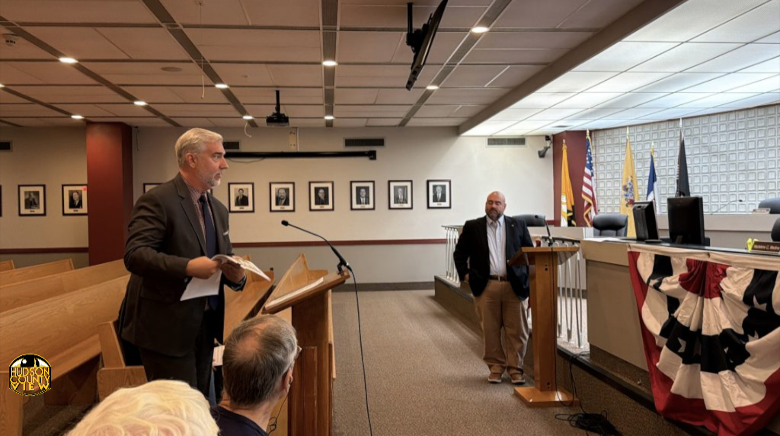
At Wednesday’s special meeting, special counsel on the aqueduct project, attorney Eric Tomaszewski, explained the purpose of the resolutions to the council at the request of Council President Melissa Godesky-Rodriguez.
The first two resolutions approve temporary water pipeline construction easement agreements with both Jersey City Urban Edge, LLC and Hugo Neu Kearny Development for property they own near the project on the Bayonne and Kearny sides of the Hackensack River.
“So, what we’re looking at here is a small section of City of Bayonne’s water supply aqueduct,” Tomaszewski said.
“The purpose of this aqueduct is Bayonne gets a fair portion of its water from the North Jersey district water supply in northern New Jersey. So it takes significant effort to get it here.”
According to Tomaszewski, the existing pipeline that runs underneath the Hackensack River and into Bayonne is 49 years old.
In addition to being an older piece of infrastructure, the pipeline has also been the subject of significant leaks in the past.
Due to the nature of this portion of the pipeline resting beneath the river, he said a leak here could cause problems down the line.
“This particular project is critical for Bayonne because it’s underneath the Hackensack River,” Tomaszewski said.
“If there is a significant leak in the pipeline under the Hackensack, it will naturally be very difficult to detect that leak, if not impossible. And so, from an operational necessity perspective, it’s critical that this project move forward.”
Tomaszewski said the city also has a “significant regulatory necessity” for this project with the New Jersey Department of Environmental Protection (DEP).
The replacement of this section of the line is an ongoing condition of the city’s water allocation permit with the DEP, and this particular part of the project has to be done by June 30, 2028.
“The length of time that will take to complete this project is a little bit in flux, but eighteen months will be more than sufficient time to cover it,” he said.
“There are permits that have to be applied for in order to begin this work from the DEP. Land use permits and other permits from the DEP.”
According to Tomaszewski, in order to apply for certain permits from the DEP, the city must first secure certain property interests that are necessary to complete this project, thus what the easements are for.
“There’s a Jersey City Green Acres parcel. There’s a Jersey City right-of-way parcel. There’s two parcels with Hudson County, and there are two parcels with private owners, Joseph Scibetta and Urban Edge,” Tomaszewski said.
The easements for the properties owned by Joseph Scibetta – for which the city has already penned an easement agreement in 2025 approved by the previous council – and Jersey City Urban Edge, LLC, on the east side of the river are only necessary for staging.
According to Tomaszewski, this project has a combination of horizontal directional drilling before line the future aqueduct with the necessary piping.
“In order to drill under the river, you have to drill some ways down, drill turns, and then drills horizontal under the river,” he said.
“That’s a portion of the project. And then there’s also a portion of the project that will involve lining the the line. In order to do that line, it’s for intents and purposes PVC piping, they have to lay the line out in segments.”
Tomaszewski said those segments are thousands of feet long, and so the necessity of having Scibetta’s property and the Urban Edge property – as well as the Hugo Neu property in Kearny – relate to not only the staging of equipment for the overall project, but also laying down the pipe in sufficient length to thread it into the line.
“The Hugo Neu property also has temporary construction easement requirement to do work on it, but when that work is done, there’s going to be permanent infrastructure related to the line that will be in place on Hugo Neu property as well,” Tomaszewski said.
“So before the council, we have three easement agreements. The first one that was mentioned is the temporary construction easement agreement with Urban Edge. There is also a temporary construction easement agreement with Hugo Neu, and there is a permanent easement agreement with Hugo Neu.”
According to Tomaszewski, the easement agreement with Scibetta was secured in 2025 after years of negotiating after that property owner demanded compensation for the ease.
That resulted in the city agreeing to pay Scibetta $15,000 per month from December of 2025 to the end of June of 2028 to maintain control over the property, although Tomaszewski wagered it cost more than if the city took other options like condemnation.
“Our office, in conjunction with the city’s preferred condemnation appraiser Mo Stock reviewed Mr. Scibetta’s demand, and Mo Stack’s opinion is that that compensation was likely far greater than what he would have commanded if we had pursued condemnation on a market rate basis,” he said.
“By comparison, the city’s getting the easement agreements relatively inexpensively. Urban Edge is admittedly a much smaller property than Mr. Scibetta’s. It’s actually difficult. It’s a small, very small triangle on the eastern shore of the property.”
According to Tomaszewski, in contrast with Scibetta, Urban Edge are only requiring a one-time $25,000 fee and reimbursement of their legal fees and other expenses, which as of right now amount to less than $2,500.
Hugo Neu has not made any requests for compensation, either fees or costs, or being compensated for the uses.
“There is on the Hugo Neu property a bulkhead that is adjacent to the work area, and there are provisions in that agreement that if the work that is done somehow damages the bulkhead in any capacity, you’ll have to make restoration of that bulkhead, but the contractor doesn’t anticipate that the activities will be of such a measure that that doesn’t anticipate here,” Tomaszewski said.
He added that the financing for the payments to Scibetta, and the payments that are proposed these easement agreements to Urban Edge and Hugo Neu, all come from the rate stabilization fund.
“It is one pool of money on the city’s concession agreement, and it is available to pay for these expenses,” he said.
The estimated cost for this project is currently estimated about $32 million, of which Bayonne has already applied for, and received approval, for I-Bank financing from the state.
“That’s a significant achievement for the city. That is only made possible by a recent amendment to the concession agreement,” Tomaszewski expressed.
“Capital projects under the concession agreement that aren’t able to be paid for through the normal course of capital projects, if paid for by the concessionaire, are amortized over the length of the contract, but the concessionaire charges an interest rate in excess of ten percent.”
According to Tomaszewski, the city was able to amend that concession agreement to achieve financing for capital improvement projects like this.
Business Administrator Andrew Casais noted the over $32 million project was just one phase of a larger project to redo the city’s aqueduct.
“The overall condition and extent of the improvement of the aqueduct is far greater than this,” Casais said.
“32 million is a lot of money. The entirety of the aqueduct is in need of improvement, and this is one phase of that. So this is one part of a larger conversation about improving Bayonne’s water supply and the reliability of the water supply.”
Municipal Services Director Jan Patrick Egan said that engineers have broken down the overall aqueduct replacement into segments and prioritized what needs to be taken care of most first at different points in the aqueduct.
He said this project, due to a state mandate related to the financing, has been driven to the top of the list.
“Safe drinking water is probably one of the prime things we should be worried about as a city government. And this is one step closer to making sure that our children’s children have safe drinking water,” Egan said.
Godesky-Rodriguez requested a timeline of other aqueduct construction projects for the council to understand the phases, but Egan said that changes day-to-day depending on the state of each segment of pipeline.
However, he said he would discuss the current prioritized segments with the council in the future, emphasizing that she of the pipes are 90 years old.