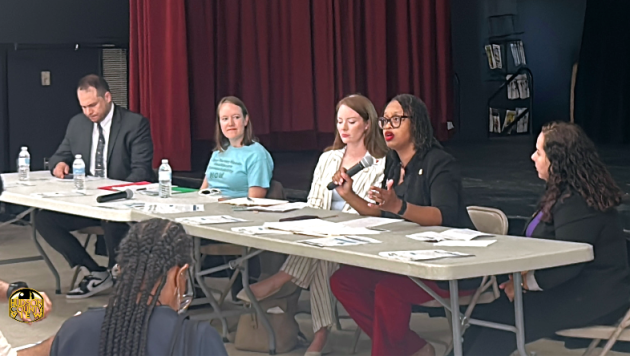
At a Jersey City town hall last night, elected officials joined union members and faith leaders to rally behind bills moving through the state legislature seeking more healthcare accountability.
By Dan Israel/Hudson County View
Throughout the evening, state Senator Angela McKnight (LD-31), who hosted the event, and other panelists described the importance of the Healthcare Accountability Law – better known as S-3012/A-1729 in the state Senate and Assembly, respectively.
The bills, backed by the Coalition for Affordable Hospitals, offer a solution that tackles the root cause of the rising healthcare crisis, she said, in part by creating more state oversight on healthcare spending and establishing more price transparency for patients.
“Patients deserve to know what care costs are before they receive a bill. Real price transparency is not optional,” McKnight said at the Mary McLeod Bethune Life Center.
“It is a basic standard of fairness and accountability in a system that affects everyone. We need stronger oversight of hospital finances and health spending.”
She added hospitals that benefit from the non-profit status should demonstrate community benefits if they are saving money through receiving property tax breaks.
However, often times hospitals charge commercially-insured patients three times what Medicare is paying for the same services.
“We want hospitals to operate with meaningful transparency, especially when patients and communities struggle with high costs,” McKnight asserted.
“Elected officials, and all of you, need to understand where money is going and whether the public is getting adequate value for what we are paying for. Price variation for the same services is not only confusing, but it prevents people from seeking the care that they need, especially when there is no real competition.”
McKnight argued that hospital systems across New Jersey often function like a monopoly, leaving patients without a choice in how they receive care.
In addition, she said the legislature is aware of the issues with the State Health Benefits Plan, but emphasized the healthcare affordability prices impact all New Jerseyans – not just public workers.
Jersey City Mayor James Solomon thanked those in attendance for joining the healthcare conversation, acknowledging the presence of labor unions 32BJ SEIU, the Hotel and Gaming Trades Council, AFL-CIO, in addition to activist coalition New Jersey Citizen Action.
Solomon began by sharing his own personal healthcare story, culminating in beating cancer, and how access to high-quality healthcare was crucial to his survival.
“To add on the stress of finances on top as you’re fighting for your life, it is really unconscionable,” he stated.
“It’s our broader American healthcare system that creates that, but specifically we see hospitals really, really, really driving the ball through the roof. They’re rising significantly higher than inflation.”
With those combined factors, Solomon said costs increases are being felt throughout New Jersey but especially in Jersey City, something made worse by the illegal closure of Heights University Hospital and the overburdened Emergency Room at Jersey City Medical Center.
“Our health insurance costs in the initial budget, before we took some steps, was $195 million,” Solomon said.
“We had to budget for healthcare insurance, it’s about a $750 to $800 million budget. So healthcare is driving our costs as a city and something that we have to be able to think about. And then it’s driving the personal costs that every individual faces.”
Solomon recalled how the number one issue on the campaign trail was affordability, with residents describing having to choose between paying rent, sending their child to an after-school program, or purchasing their prescription drugs.
He said that these choices should not be forced on working people, calling for a living wage so people have the dignity to afford decent health insurance and healthcare.
“We need change in the hospital industry,” Solomon said.
“We had something like 70 hospital groups, and now we’re down to 29 in New Jersey. So we’ve seen a remarkable reduction and that consolidation means less competition. And when corporations feel less competitions, they start operating like monopolies.”
According to Solomon, the Healthcare Accountability Law will address the hospital system monopolies by “accurately reflecting this market failure” in the lack of corporate competition.
New Jersey State Director and Vice President of 32BJ SEIU Ana Maria Hill said that their contracts include employer-paid healthcare where they pay 100 percent of health insurance costs.
However, as prices increase that means that when they are at the bargaining table for a better contract that the portion required to pay for healthcare increases to the detriment of other items.
“The pie is always the same and how they cut it changes things,” Hill began.
“When we’re bargaining and they’re ready to strike and they’re saying ‘I need more money in my paycheck,’ the employers say ‘Well, then how much is everything else going to cost in this pot?’ And that healthcare slice just keeps getting bigger and bigger.”
According to Hill, 40 cents of every dollar that they are bargaining for goes to healthcare. She said that while cost of rent and groceries increased by 40 and 30 percent respectively over the last 10 years, hospital pricing has gone up over 100 percent.
Hill said this leads to people postponing health appointments due to fears of exorbitant bills, but the solution is taking healthcare back through measures like the Healthcare Accountability Law.
Pastor Keith Garvin-Howell, of The Sanctified Church in Jersey City, also the president of evidence-based cancer prevention and research organization the Witness Project of New Jersey, is a hospice chaplain who is constantly at hospital bedsides engaging with patients.
“I see working families who have insurance on paper but still cannot afford treatment in practice. I see seniors at my congregation who have to ration medication because prescriptions cost too much,” Garvin-Howell recalled.
“I see people postponing doctors’ visits because they’re afraid of copays or deductibles and the amount of medical debt that they would end up incurring after. And tragically, in hospice care, I often meet people who, after conditions have progressed much further than they should have, not because they didn’t care about their health, but because the access to healthcare became too expensive.”
Garvin-Howell said that’s why the Healthcare Accountability Law is important, because healthcare costs are not just economic issues, but moral, community, and human dignity issues.
Assemblywoman Katie Brennan (D-32) joined her fellow electeds in decrying the state of healthcare in Hudson County, in New Jersey, and across America.
“Healthcare is a human right,” Brennan declared.
She echoed that patients can’t compare the prices of healthcare between hospitals due to the lack of transparency on the part of the hospital system monopolies.
Brennan said that the cost of healthcare is increasing, not because of better or quicker care but because of healthcare executives and the for-profit industry are not being held accountable.
“We didn’t have the tools to effectively hold HRH accountable for what they were doing,” Brennan said of Hudson Regional Hospital’s illegal closure of Heights University Hospital.
“We’re going to get tools to hold hospital systems accountable so they cannot do what they did at Christ Hospital. And we’re going to get the tools that we’re talking about tonight to hold them accountable for what we are paying for and what we are getting.”
After the panel of speakers concluded their presentation about the Healthcare Affordability Law and how it is an important step towards a healthcare system that works for patients instead of corporations, they engaged in a question and answer session with those in the audience.
Shortly after Heights hospital closed, the Jersey City Council approved a resolution seeking to explore the possibility of eminent domain, as HCV first reported.
After a New Jersey Department of Health hearing was cancelled in the 11th hour after a judge approved a court injunction for HRH since they had withdrawn their certificate of need, an impromptu town hall had dozens of residents express their anger.