The Jersey City Council examined an ordinance on first reading that would give 10 percent of payment in lieu of taxes (PILOTs) revenues to the local board of education (BOE) during yesterday’s caucus.
By Daniel Ulloa/Hudson County View
The measure was briefly discussed as a new PILOT for the Canal Crossing project, boasting 20 percent affordable housing and $1,000 rents, was reviewed earlier in Monday’s caucus.
Around that time, Deputy Mayor for Housing and Economic Development Keshav Poddar acknowledged that former Mayor Steven Fulop had signed an executive order in April 2017 to give 10% of tax abatement revenues to the school.
However, Poddar echoed what city spokesman Nathaniel Styer told HCV on Friday.
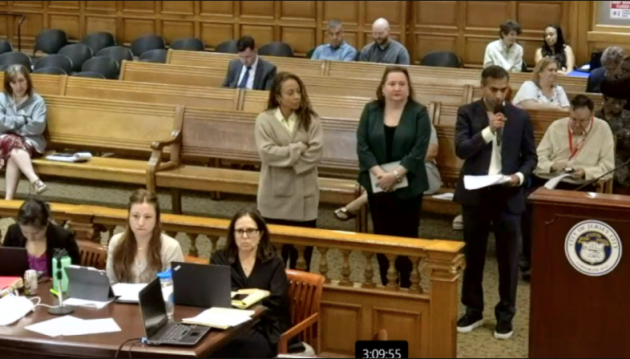
“In 2017, the prior administration issued an executive order saying it would share 10 percent of future pilots with the school district. That order was never actually implemented,” he told the City Council.
“Our proposal is to dedicate 10 percent of … PILOTs for a school infrastructure capital fund.”
Ward E Councilwoman Eleana Little commended the administration for recommending this, but added she would like to see a higher allocation, something in the neighborhood of 20 to 30 percent.
Poddar responded that the 10 percent number came about as a compromise.
“It’s also an attempt to improve capital improvement. There is a need for right-sizing we have to do,” added Deputy Mayor for Education Dr. Dia Bryant.
Councilman at-Large Rolando Lavarro wanted estimates of the impact of the plan.
“I can tell you which projects would be affected retroactively,” Poddar began.
He noted that the PILOTs affected by the ordinance are those in development and would include Bayfront, Penrose Place, 708 Pavonia Ave., the Downtown embankment, and the Sussex Street project, among others.
Lavarro was curious about the regular amount of taxation of such projects versus PILOTs.
“How did we get to that number?” he questioned.
“The promise was made to share 10 percent … We think it is fair percentage,” Poddar answered.
Ward D Councilman Jake Ephros was curious about the oversight committee for the Education Infrastructure Capital Fund.
“It is the oversight for any money that goes into that fund,” Bryant noted.
As Mayor James Solomon’s office said Friday, Poddar noted that the committee would include the mayor’s designee and a senior municipal official appointed by the mayor, a BOE representative and the superintendent or designee, a resident appoint by the mayor, and a non-voting City Council liaison.
“Is there any opportunities out there for us to get matching from them [the New Jersey School Development Authority]? It is their job to make the improvements,” declared Councilman at-Large Michael Griffin.
“Their criteria for building is very specific, and we don’t currently fit that in all our neighborhoods,” Bryant responded.
Lavarro then again asked how they arrived at the 10 percent figure.
“ … Remaining at that level was the best way to balance bringing in new funds for these capital projects, while also protecting the city’s interests,” Poddar answered.
“Is there a way to allow a certain other percentage to alleviate some of the burden on small home owners?” Little asked.
Bryant said they are trying to provide revenue to the schools before Jersey City Redevelopment Agency attorney Jennifer Credidio chimed in.
“If we provide funds as part of the operating budget, the control over what those funds are used for would not revert to the City Council. It would not necessarily prevent the raising of taxes … It would be received as miscellaneous revenue,” she explained.
“If we were to do an additional 10 percent for operating, is that something that is feasible?” Little questioned.
“It’s problematic because there would be no City Council participation in the expenditure of those funds … It may not actually have a tax reduction effect,” Credidio replied.